 aionedge.
These are the trending Jev posts that drove most of the attention after launch, ranked by reach. Each one is shown below exactly as posted, with a still from its video, followed by what the claim is, whether anyone has checked it, and what a builder should take from it. Figures in the posts are the posters' own.
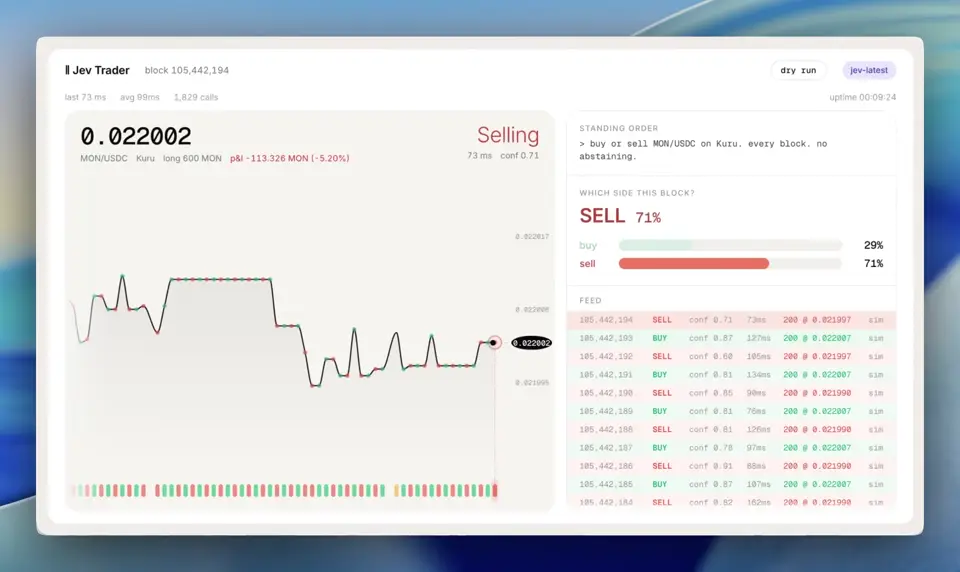
The Jev trading bot post that reportedly lost $31,680 (@MoonGotchi)
Jev is INSANE.
I built this in an evening and morning. A real-time trading bot ingesting onchain+offchain data to make rapid decisions about trades. Fully autonomous.
So far it has lost me $31,680.
 Still from video
This is the single most-shared Jev post so far, and it works because it inverts the "Jev is insane" template. For builders, the lesson matches what the serious trading experiments already say. The open source jev-trader project, which places orders on a live order book, lets Jev choose buy or sell while ordinary code controls size, limits and whether to trade at all.
json-render + Jev: instant generative UI (@ctatedev)
New experiment: json-render + jev
The future Generative UI is instant
Your components, your actions, your design system
Rendered in milliseconds
 Still from video
This is the clearest example of the pattern the whole ecosystem is converging on: prepare a closed set of options, let Jev choose, and let deterministic code assemble the result. The json-render repository is in our index with a link to the exact code path.
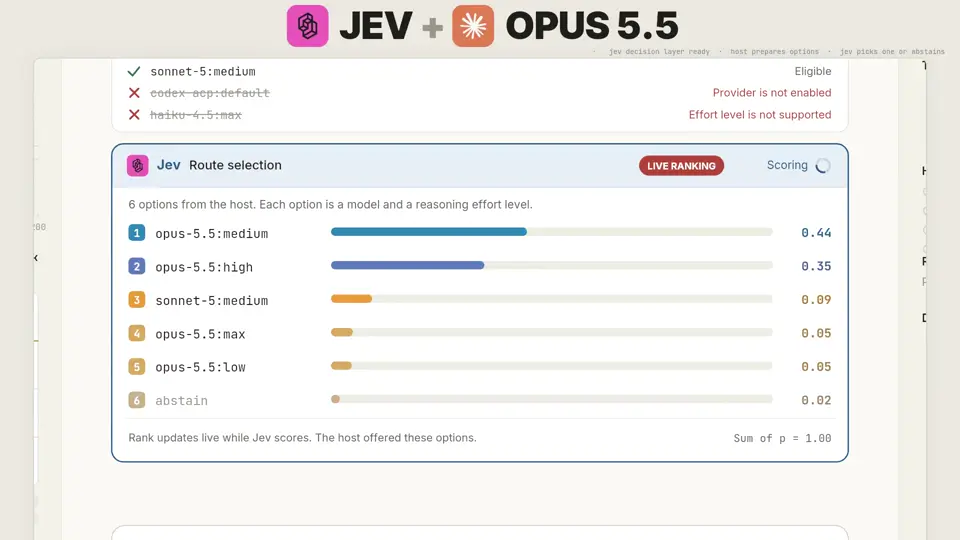
Jev + Opus 5.5: the coding workflow post that reportedly cut costs 80% (@Av1dlive)
jev + opus 5.5... i simply can't comprehend why everyone isn't building this yet.
in my workflow, this cut costs and time by ~80%. i think it's one of the best ways to use it.
→ pick relevant project notes before loading the context
→ route suitable tasks to a faster worker
→ choose a recovery path when a tool fails
→ run focused checks before the full test suite
opus handles the hard reasoning. jev picks from options the harness prepares and validates.
i explain how to build the decision layer in the article below:
 Still from video
The division of labour is the same one you see across coding-agent projects in our index: the large model reasons and writes, and Jev chooses between options the harness has already prepared and validated. Routers such as jev-codex-router and review tools such as jev-review apply exactly this split.
Jev for sales outreach: 700 leads scored, and a concept-video disclosure (@romanbuildsaas)
JEV is INSANE.
We gave it 700 high-intent leads and personalised outreach messages.
In 40 seconds, it predicted how each message would perform, assigned a confidence score and detected lead-message mismatches.
All for just $0.09.
JEV can also score leads, analyse buying signals, match each prospect with the best message and identify the campaigns most likely to perform based on data.
Coming soon to @GojiberryAI+ MCP.
Comment “JEV” for early access.
 Still from video
Thirty seconds later the same account posted a clarification, and a reply questioning the launch-week hype picked up traction of its own:
Video above is concept preview only, not actual product footage.
Try https://gojiberry.ai here free for 7 days to get an early access on the JEV integration!
@romanbuildsaas I dont' know man, it does feel a bit orchestrated
Jevmaxxing for marketers: seven marketing workflows (@korzhov_dm)
Jevmaxxing for marketers
Jev can speed up most marketing workflows 30x and do it for < $3:
1/ Scan the whole Meta Ad Library
-> It reads every live ad in your category and tags each one by hook, format, offer and days running
2/ Find the ad patterns that survive
-> It compares formats by how many ads are still live after 60 days, so you know what lasts before you test it
3/ Score briefs before you shoot
-> Your LLM writes the briefs, Jev scores each on hook, brand fit and survival odds, and only the top ones get made
4/ Sort search terms
-> It asks "is this query from a buyer?" across the full Google Ads report, so negatives land the same night
5/ Catch fatigue early
-> For every ad with frequency up and CTR down, it picks replace, refresh or leave
6/ Check ad to landing page match
-> It scores whether the page delivers what the ad promised, the cheapest CVR fix in most accounts
7/ Score every lead
-> It rates each form fill 0 to 100 against your ideal customer within seconds, so Google and Meta learn to find more of the good ones
Available in the Ryze AI app and MCP/Claude Connector, link in the 1st comment 👇
 Still from video
Marketing is where the "decide, don't write" framing clicks fastest. None of these seven jobs needs new copy; each needs a consistent verdict applied to thousands of rows.
The Jev GitHub projects roundup thread (@imryven)
Jev has been exploding across GitHub since launch, here's what people have already built with it
if you have API access and don't know where to start, copy this:
jev-trader - real trading bot placing live limit orders on Monad every 300ms block, judged by Jev alone. 1,911 stars
https://github.com/jarrodwatts/jev-trader
jev-ultrafast - browser agent that picks every click itself, only calling a text model when it actually needs to type something. 16,758 stars
https://github.com/browser-use/jev-ultrafast
jev-doom-agent - real Chocolate Doom compiled to WebAssembly, two engines running the same map, Jev picking the tactical macro every frame
https://github.com/lukaske/jev-doom-agent
jev-t-rex-runner - the Chrome dinosaur game you've procrastinated with a hundred times, now played entirely by Jev picking jump, duck, or keep running
https://github.com/joshlarsen/jev-t-rex-runner
typesafe-chess - Jev vs a real search engine, two games, colors swapped. the search won both, but overruled Jev's first instinct on roughly half the moves
https://github.com/TholeG/typesafe-chess
jev-drone - a simulated quadrotor clears a five-station obstacle course by camera alone, Jev judging the situation twice a second
https://github.com/RomanSlack/jev-drone
tax-doc-classifier - sorts real IRS tax forms with 100% strict accuracy across 261 forms, at roughly $0.001 a page
https://github.com/kyotofin/tax-doc-classifier
killmyidea - describe your startup idea, Jev scores it from every angle, then hands back kill, fix, or ship
https://github.com/monteduro/killmyidea
jev-curate - streams Parquet and JSONL rows through typed judgments at 1,500+ rows a second, keeping only what clears the bar
https://github.com/AkashPriyadarshii/jev-curate
pg-jev - a PostgreSQL extension that lets you ask your own database tables plain-English questions and get a real answer back
https://github.com/realZachi/pg-jev
none of these ten generate a single word of text. every one of them returns a number against an answer someone already defined
full setup below, then run the three-question test from the article before you build an eleventh
 Still from video
Every repository this thread mentions is listed, with current star counts and a link to its Jev code, on our page of trending Jev projects on GitHub.
Grep's agentrun() harness: compliance alerts for a fraction of the cost (@_aj)
We built a new harness using @typesafeai's Jev that cuts the cost of repetitive work by 90%. The harness learns the job as it runs, moving steps from LLM calls to code.
Running 100,000 compliance alerts costs >$290K on Opus 5.
With agentrun() we got it down to <$26K.
The Stanford data science post: 40 billion data points reportedly every 15 minutes (@deezzex)
a Stanford professor used JEV to build a data science system that analyzes 40.000.000.000 data points every 15 min
his system can process massive datasets and automatically decide which results deserve deeper analysis.
the professor spent more than a year developing the system with his research team.
the first version relied heavily on LLMs to interpret every result.
it worked, but analyzing millions of records created unnecessary latency and huge inference costs.
then they redesigned the decision layer around Jev.
instead of generating explanations for every data point, Jev evaluates the results and decides what the system should investigate next.
I found a breakdown of the pipeline they used and the way Jev filters the data is surprisingly clever.
I’ll show you how it works next so stay tuned if you want to see what Jev Engineering looks like inside a real data science system.
would you let an AI decide which patterns in your data are worth investigating?
 Still from video
Want the concept rather than the claims? Start with our guide to what Jev is, see the best Jev explainers, or read how the story played out in the coverage in the press.
Frequently asked questions
What are the trending Jev posts right now?
The most-shared Jev posts are a trading-bot post whose author says it lost money, Chris Tate's json-render generative UI experiment, a Jev plus Opus coding workflow, a sales outreach concept video, a marketing workflow thread and a GitHub projects roundup. All of them are shown in full on this page.
Did the Jev trading bot really lose $31,680, as the poster claims?
That is the poster's own claim and it has not been verified; the post may be satirical. Either way, it is a fair warning: Jev can make fast decisions, but that does not make the decisions profitable.
Is the json-render + Jev demo real?
Yes. Chris Tate presented it as an experiment and the json-render code is public. Jev chooses from predefined components and properties rather than generating a new interface.
Where can I find the GitHub projects mentioned in these posts?
Every repository mentioned in these posts is listed on the AionEdge trending Jev projects page, with star counts, licenses and links to the code that calls Jev.
Why show the posts here instead of linking to X?
So you can read each post and the fact-check side by side, without an account or a feed in the way. Each card keeps a source link to the original for attribution.
Sources
1,260 repositories across 30 categories, each linked to its source.