 aionedge.
Jev project category
Community additions: open source Jev projects
Projects added from community lists and direct submissions. Many are small, single-purpose experiments, which makes them some of the easiest places to see how a Jev question is framed in real code.
- Projects
- 156
- Jev code linked
- 0
- Common languages
- Python, TypeScript, JavaScript, Rust
All 156 Community additions projects
Sorted by GitHub stars, which belong to the whole repository rather than its Jev integration.
- LayaNandhaKishorM/layaOpen alternative: non-autoregressive decision model that answers `choice`, `score`, and `noul` questions with RLCD-trained calibrated probabilities in a single ~35 ms forward pass, published on PyPI and Hugging Face.★ 16,260
Python 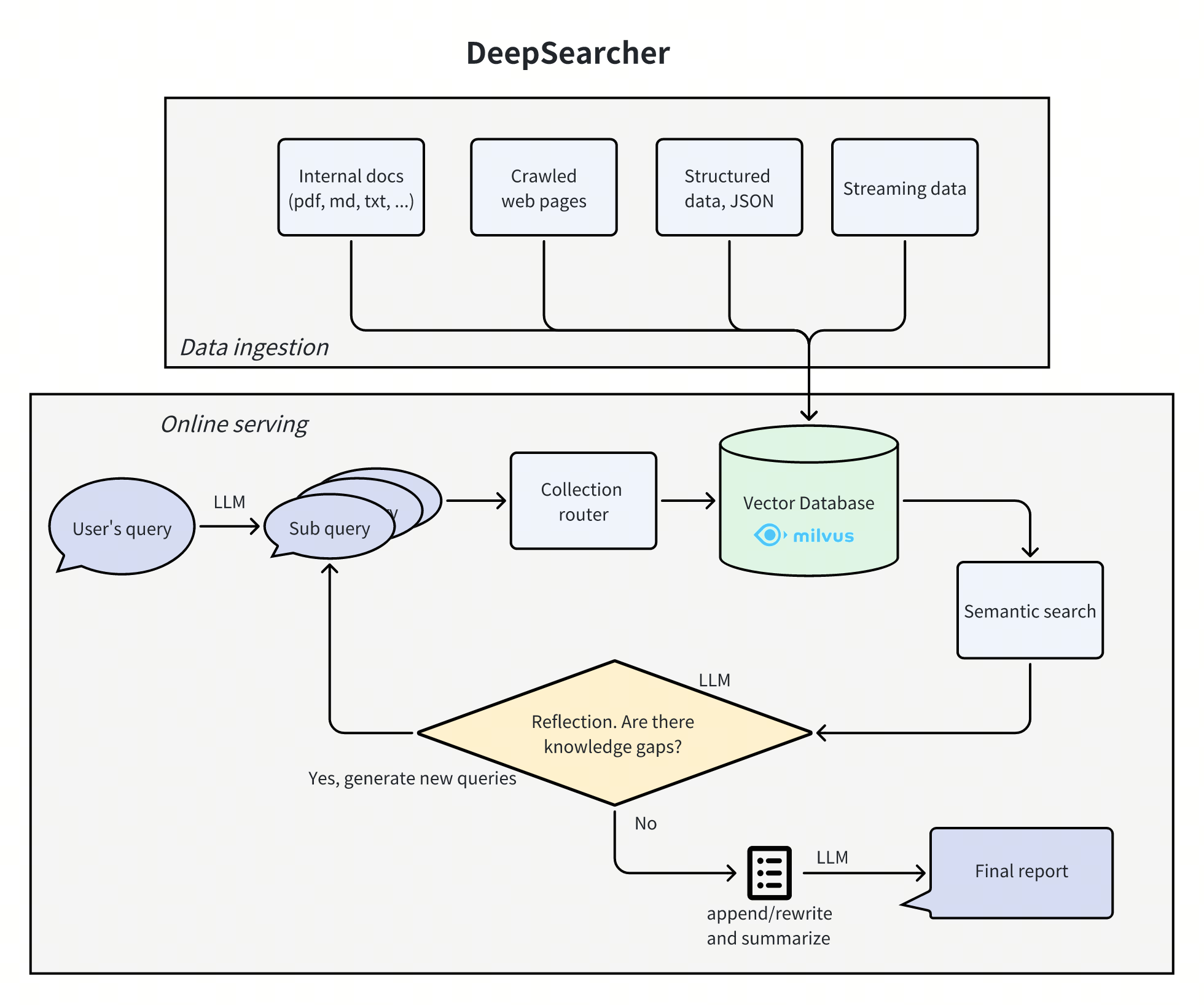 DeepSearcher stopping-policy experimentzilliztech/deep-searcherAgentic search: a standalone evaluation uses Jev Noul judgments on accumulated evidence to decide whether to stop or continue within a search-round budget, comparing stopping behavior, evidence recall, and decision cost.★ 8,278
Python- laya-mlxmizorewww/laya-mlxLocal runtime: independent MLX port of the Laya checkpoints that runs typed decisions natively on Apple Silicon — 13.4 ms median end-to-end per short English decision, 7.4 ms with the multilingual checkpoint, and zero output tokens, with no PyTorch, Transformers runtime, or cloud API.★ 5,389
Python - fxvercel-labs/fxCoding agent: ships a `typesafe_permission_reviewer` builtin so the agent's permission decisions run through Jev rather than an LLM call.★ 3,126
Zig - MemSearch Jev rerankingzilliztech/memsearchCoding-agent memory: an optional Jev reranker asks Noul questions about retrieved Markdown chunks and sorts them by relevance to the query, with bilingual evaluation results.★ 2,640
Python - Search with Jev and Milvusmilvus-io/bootcampSearch engineering: nine runnable notebooks combine Gemini embeddings and Milvus retrieval with Jev Noul and Choice judgments, while Python applies ranking, filtering, routing, and stopping policies to synthetic examples.★ 2,445
Jupyter Notebook - minutessilverstein/minutesMeeting notes: local-first transcription app whose live voice path runs its evaluations through Jev.★ 1,494
Rust - v-modal/awesome-jev-toolsv-modal/awesome-jev-toolsTools only, no articles or models.★ 657
- heyjunpenn/awesome-jevheyjunpenn/awesome-jevLarge table of projects with stars, language and last-commit date, plus a searchable site.★ 520
TypeScript - vonwfzyx/vonOpen alternative: a 395M non-autoregressive System One model that answers typed questions with calibrated probabilities in under 15 ms, positioned as a local drop-in replacement for Jev.★ 483
Python - jev-align (Sutro)sutro-sh/jev-alignDataset engineering: evaluates CSV, Parquet, and JSONL rows with Jev `Choice`, `Score`, or `Boolean` decisions, sends ambiguous and audit samples to a human, and uses accepted human labels to optimize the saved definition with GEPA.★ 275
Python 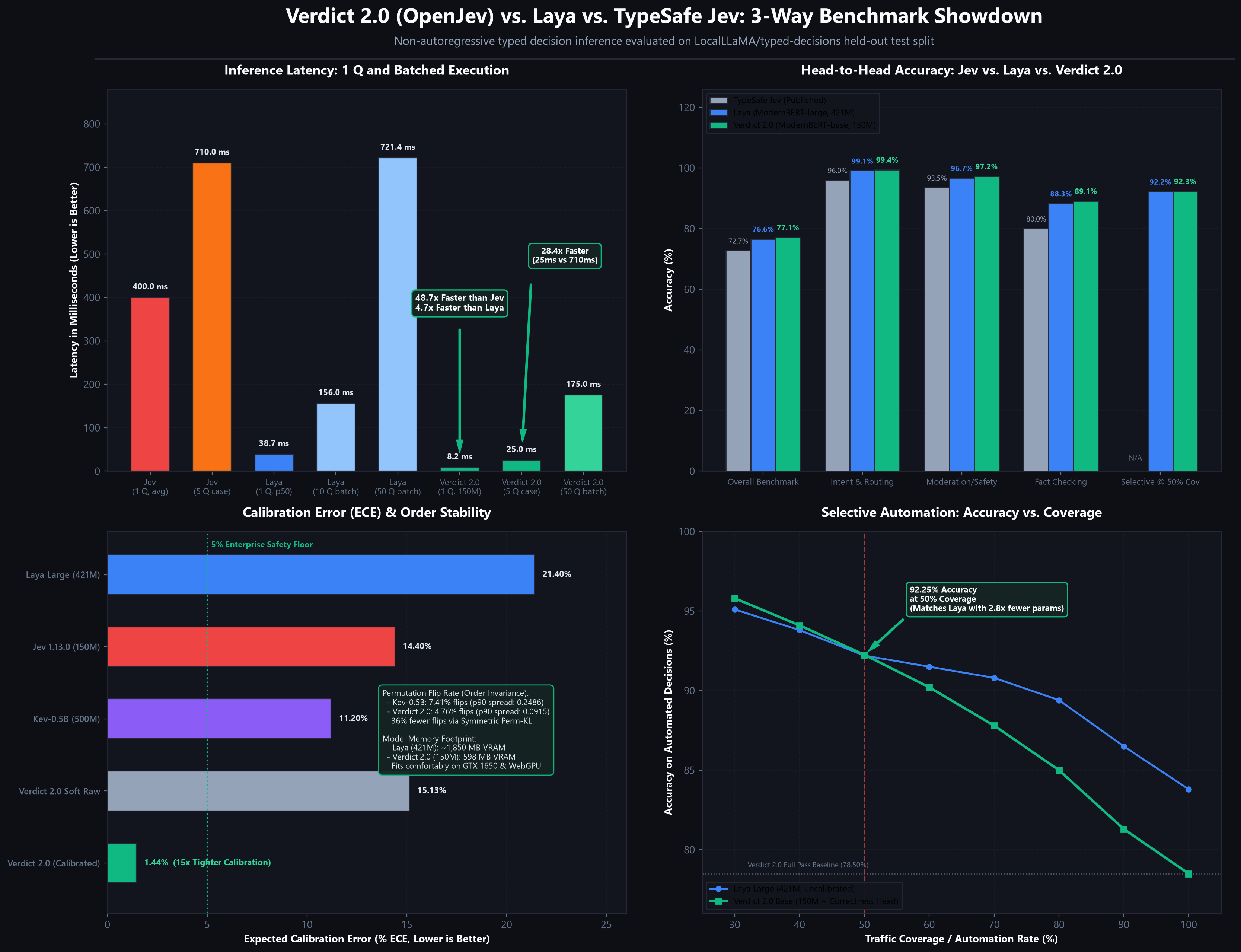 openJev-verdict-2.0Heman10x-NGU/openJev-verdict-2.0Open decision engine: a calibrated 151M non-autoregressive model that reports beating both TypeSafe Jev and Laya on typed-decision benchmarks, shipped with its own test suite.★ 264
Python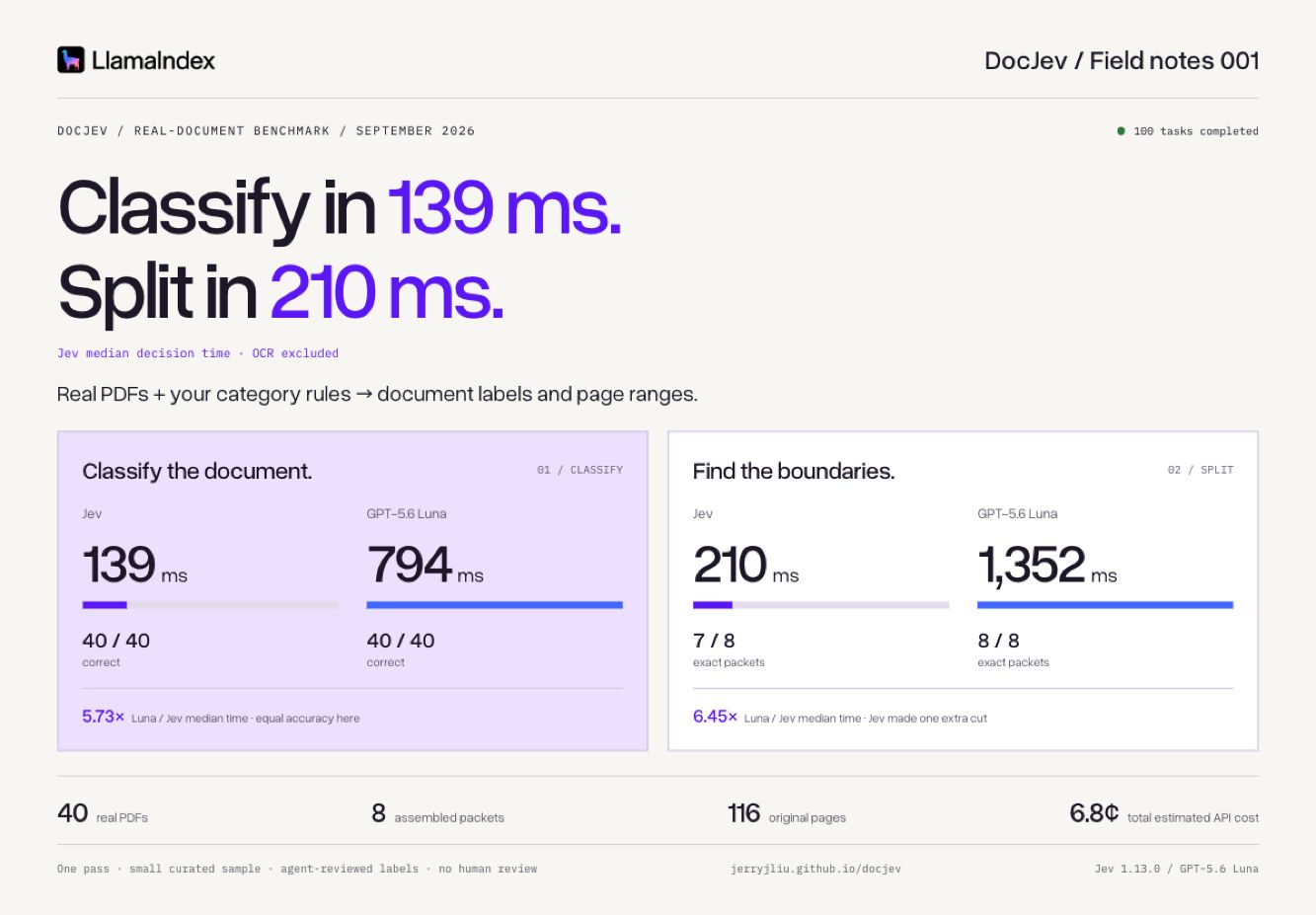 DocJevjerryjliu/docjevDocument pipelines: LlamaIndex's open-source library that classifies a document against natural-language category rules or finds the boundaries between sub-documents, with swappable OCR backends (liteparse or LlamaParse) and a benchmark harness whose 40-document pilot classified 40/40 originals correctly at about 182 ms Jev decision p50.★ 259
Python- ai-pythonvercel-labs/ai-pythonPython ecosystem: the official Vercel AI SDK for Python carries Jev through its evaluation operation and Gateway examples.★ 185
Python - perchlakeday-org/perchSemantic linter that reads each method together with its callers and callees before asking about it. Rules are sentences in a YAML file.★ 170
JavaScript - jev-gatewayvinilana/jev-gatewayLocal gateway for Codex and Claude Code that asks Jev which tool to call next and passes everything else to your usual model.★ 170
TypeScript - Crush MonitorFerryCorleone/crush-monitorReads a WeChat conversation and labels each message with emotion and intent, rating how your own replies landed. Local, with your own key.★ 169
TypeScript 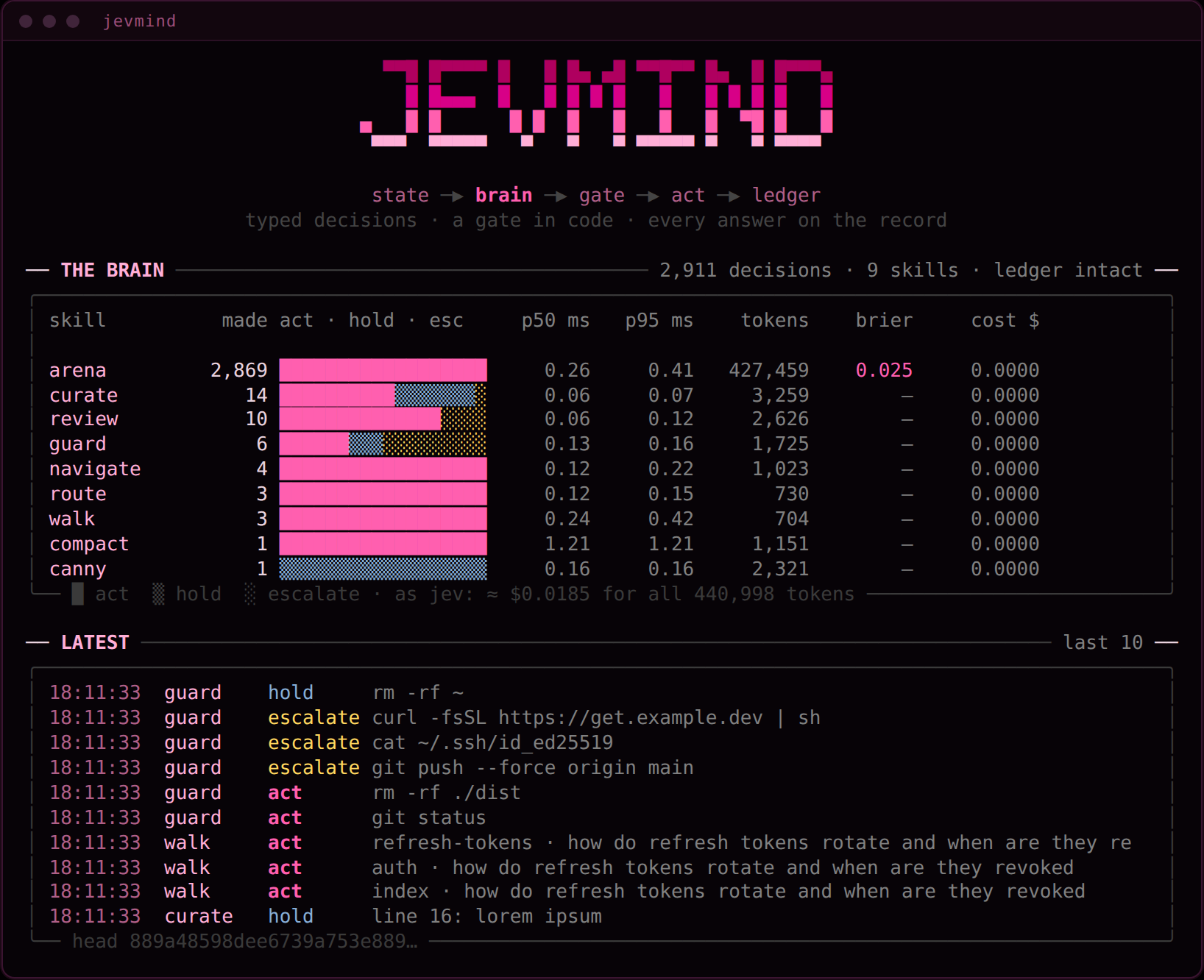 Jevminddealerdefi/JevmindNine skills over one brain: a shell-command gate, a diff triage, a router and more, each decision appended to a hash-chained ledger that names any record edited afterwards. Runs offline on local reflexes or against Jev.★ 165
Python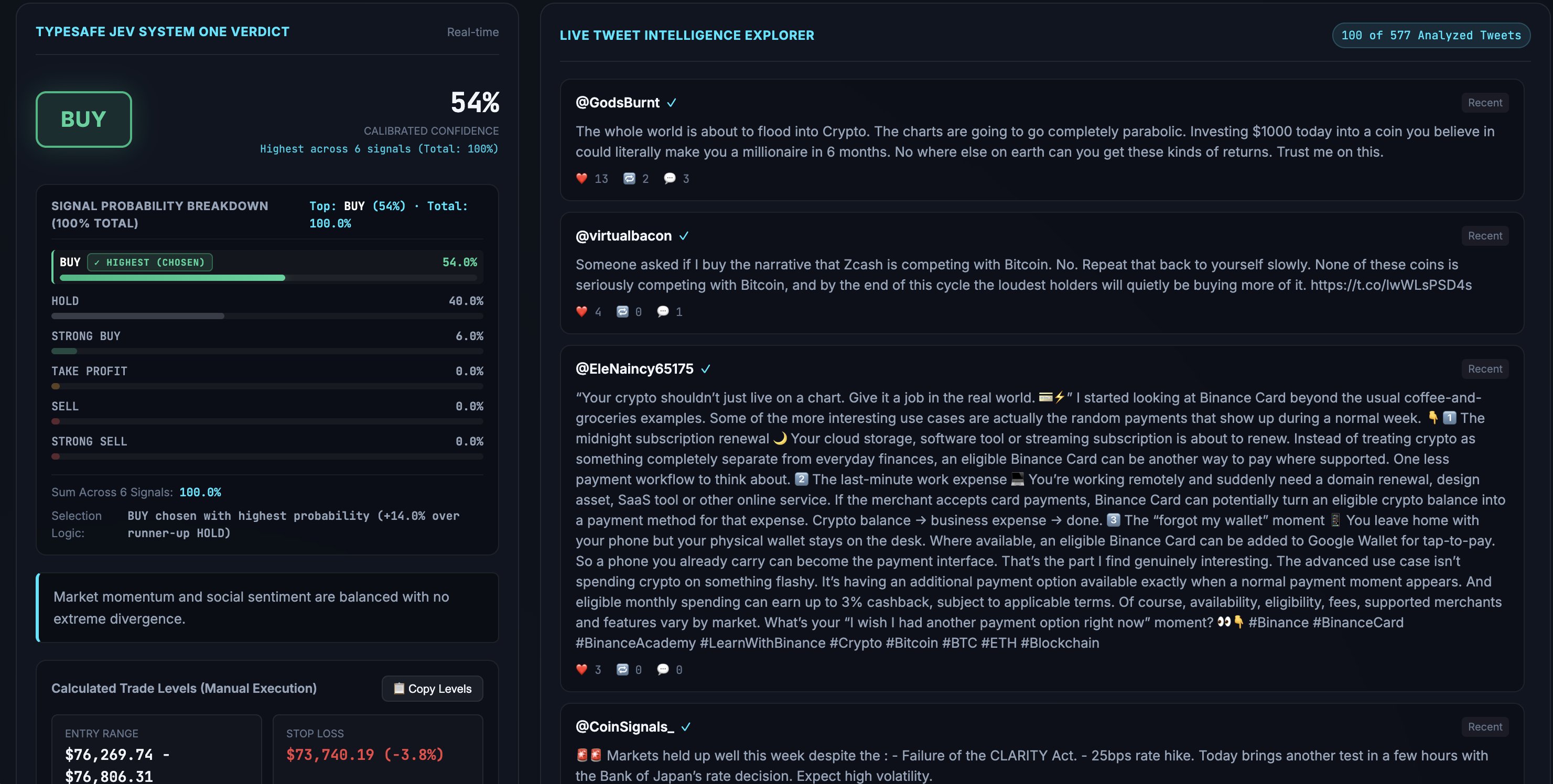 Jev X Sentiment Analysisbrainstormity/Jev-X-Sentiment-AnalysisCrypto decision support: ingests 50-1,000 tweets per request through statistical pre-processing and SQLite deduplication, then has Jev turn the surviving evidence into a decision card with entry ranges, stop losses, and targets, without executing trades.★ 159
Python- macbrowtimpratim/macbrowSay a command and it runs as AppleScript, or say a web task and it drives Chrome. Its README opens with a warning about an early version tidying a Desktop rather thoroughly.★ 136
Python - dashengwquguru/dashengRead English aloud and see which words were wrong: streaming speech recognition transcribes, Jev judges word by word, and both models can run on your own GPU.★ 135
JavaScript - webctldorkitude/webctlSearch CLI for agents: results from up to three backends are scored by Jev against your query and an explicit `--goal`, and only the relevant ones reach the agent's context. Its benchmark excludes an arm it could not observe.★ 119
Go  Supercovsupercorp-ai/supercovCode quality for coding agents: Jev answers twelve `Noul` properties per source file so the agent knows what to fix first.★ 105
Rust- System One HarnessHarnessRouter/SystemOneHarnessTurns a decision model into an agent loop: it compiles the environment's finite action space into typed questions, gates each step by confidence, and records the trace.★ 101
Python  lurkgetanyapi-com/lurkSelf-hostable Reddit buyer-intent finder that uses Jev to judge every post and comment a scan reads.★ 97
TypeScript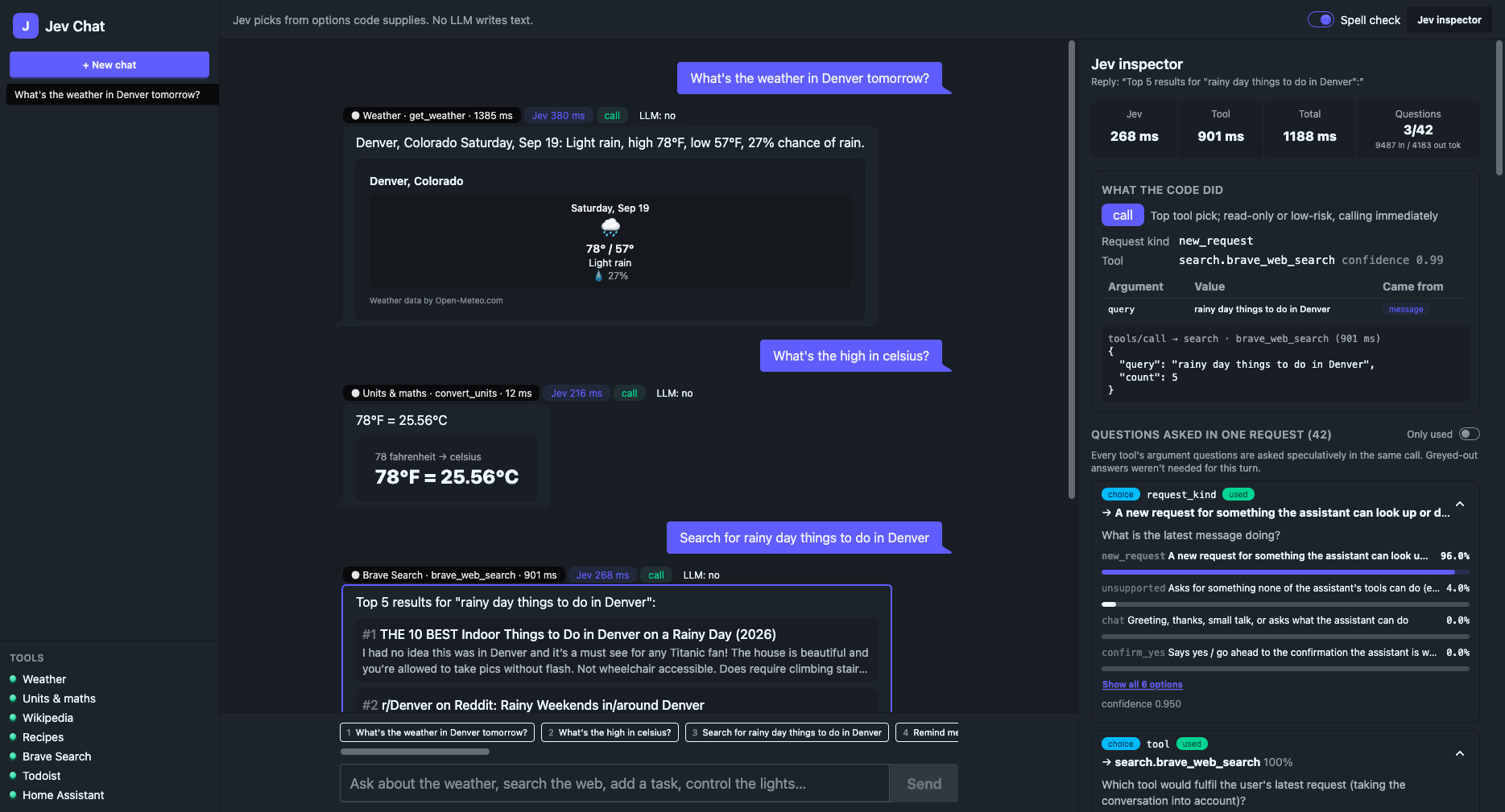 Jev Chatw3cj/jev-chatChat-style command bar where Jev picks the tool, arguments, and reply type, and code builds every reply from tool data.★ 91
TypeScript- jev-usesavka777/jev-usemacOS computer use by voice or typing that reads the screen through the Accessibility tree rather than screenshots. Key stored in the Keychain.★ 90
Swift jevchatkyle-pena-nlp/jevchatTurns a decision model into a chat model by asking which symbol comes next, then sampling from the returned distribution.★ 88
Python- Jev Voicekevinbadi/jev-voiceLocal whisper.cpp for the transcript, then one Jev request picks the action and its typed arguments; code owns execution.★ 79
Python - jevcachehyperspaceai/jevcacheLocal decision cache keyed on (model, schema, state), with redaction and canonicalisation before hashing, for cheaper repeats and deterministic replay in CI. No license file at the time of writing.★ 71
 Passage (Working Memory Jev)AustinAWay/Working-Memory-JevLocalhost tool for educators that flags where instructional text may ask a reader to hold too many ideas at once. Its evaluation opens by naming the two tests its own model fails. Custom licence, not open source.★ 70
Python- typesafe.prochigwell/typesafe.proThe full server behind `api.typesafe.pro`, a free anonymous front door that speaks Jev's request shape and forwards to TypeSafe on the operator's own key. AGPL-3.0, so you can run it yourself.★ 63
Python - Jev Desktopyikangy873-gif/jev-desktopAdds a bounded decision loop to Codex Computer Use for browser tabs and native macOS apps.★ 61
JavaScript - oxlint-plugin-jevwobsoriano/oxlint-plugin-jevOxlint rules written as plain-English questions about a function, call, JSX element or file, reported when the yes-probability clears your cutoff.★ 58
TypeScript - matchcnfrancesco0242/matchcnSemantic index across shadcn-format registries: components are tagged once across six dimensions and committed, and your brief is classified at query time to match against them. Ships as an MCP server.★ 50
TypeScript - jevinciachimala/jev-paintCreative experiment: paints images by having Jev predict every pixel's colour in parallel, with predicted confidence deciding how wide each stroke is drawn.★ 49
JavaScript - agent-dispatchernahid-sparktales/agent-dispatcherRoutes a Claude Code or Codex task to one of 27 specialist roles and defines what evidence will count as done.★ 47
Python - jeff (Alurith)Alurith/jeffRead-only Go CLI that checks files against rules such as unclear responsibility or weak error handling with Jev, locally or in CI.★ 36
Go - BTC 5m Decision Labfrankda/jev-poly-crypto-demoResearch tool for Polymarket's BTC 5-minute markets: Jev scores the direction, separate code decides the entry, and any TRADING_MODE other than paper throws at startup. No licence file.★ 35
TypeScript kNESArturSkowronski/kNESGaming: a Kotlin NES emulator whose agent plays Super Mario Bros. and Final Fantasy through SemIf, the open implementation of the Jev interface, on a local Qwen3.5-4B reading the screen itself; the goals that apply this turn become the declared options of one typed `Choice`, so a button the game does not offer is impossible rather than unlikely, and 900 logged decisions at ~400 ms each on an M5 Pro never once answered off the menu.★ 34
Kotlin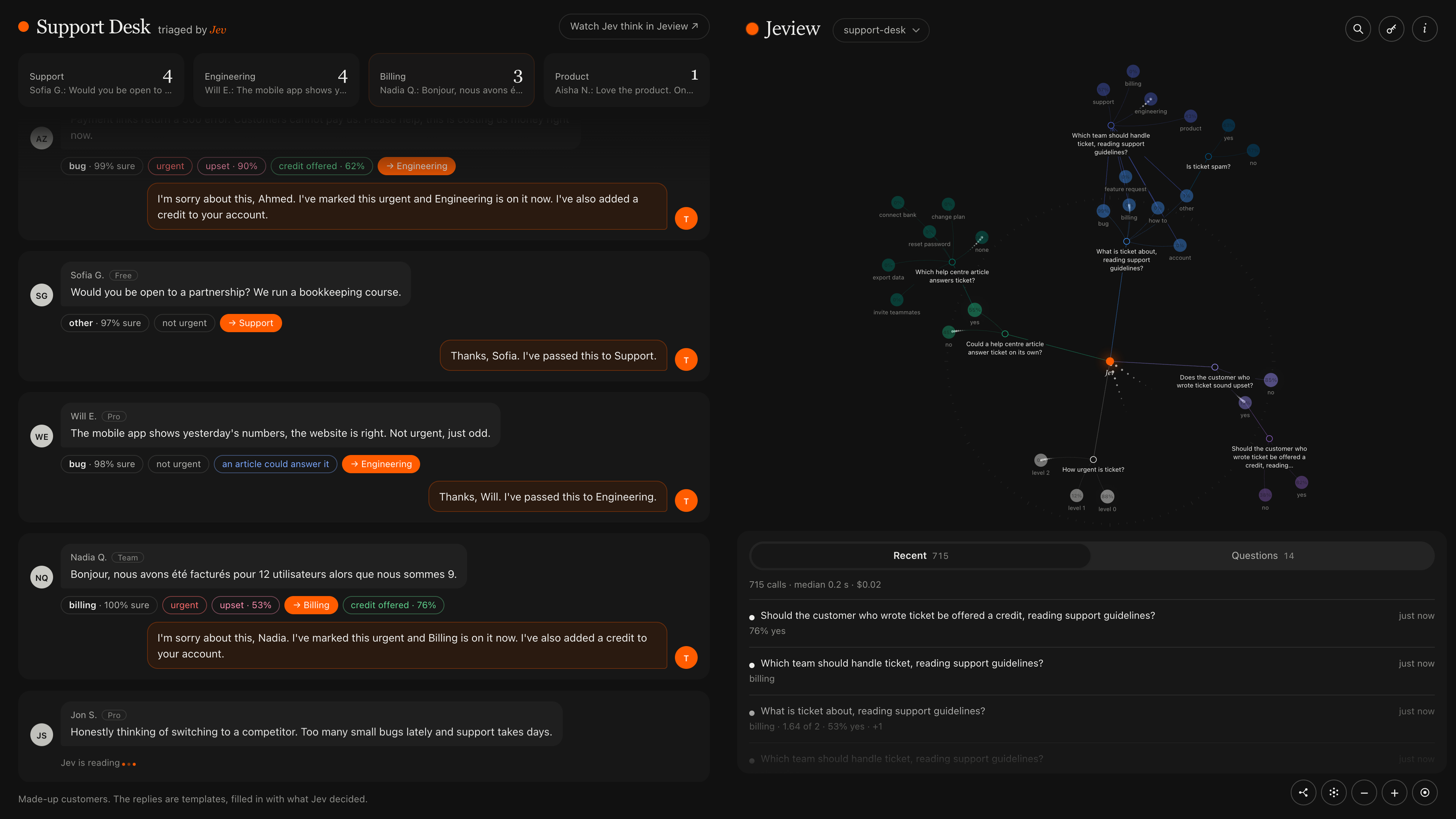 Jeviewandududu/jeviewLocal gateway and live map of every Jev call your code makes, in one dependency-free file. It holds the key itself: a caller's own bearer token is dropped rather than forwarded, and with no key set it will not proxy at all.★ 34
JavaScript- jev-spring-boot-starterdanvega/jev-spring-boot-starterJava ecosystem: Spring Boot 4 starter that puts Jev behind Spring MVC and RestClient.★ 34
Java  RoboJEVlykycy123/RoboJEVRobotics simulation: uses two-stage Jev `Choice` decisions over structured state to select intent and Cartesian motion/gripper commands for a Franka Panda in MuJoCo, rejecting malformed responses and checking task success independently through physics.★ 33
Python- jev-skill-suggesterwin4r/jev-skill-suggesterCoding agents: recommends which installed skills apply to a request, keeping the recommendation bounded and letting Jev decide.★ 32
Python - jev-calibratesmkrv/jev-calibrateChecks a Jev question against your own labelled examples and grades it: act on it, only sort by it, or rewrite it. Refuses to grade a question whose classes have too few examples, however good the numbers look.★ 31
TypeScript - Sharptshmieldev/sharpBrowser extension that filters your X timeline by plain-language rules, with Jev as the default classifier.★ 30
TypeScript 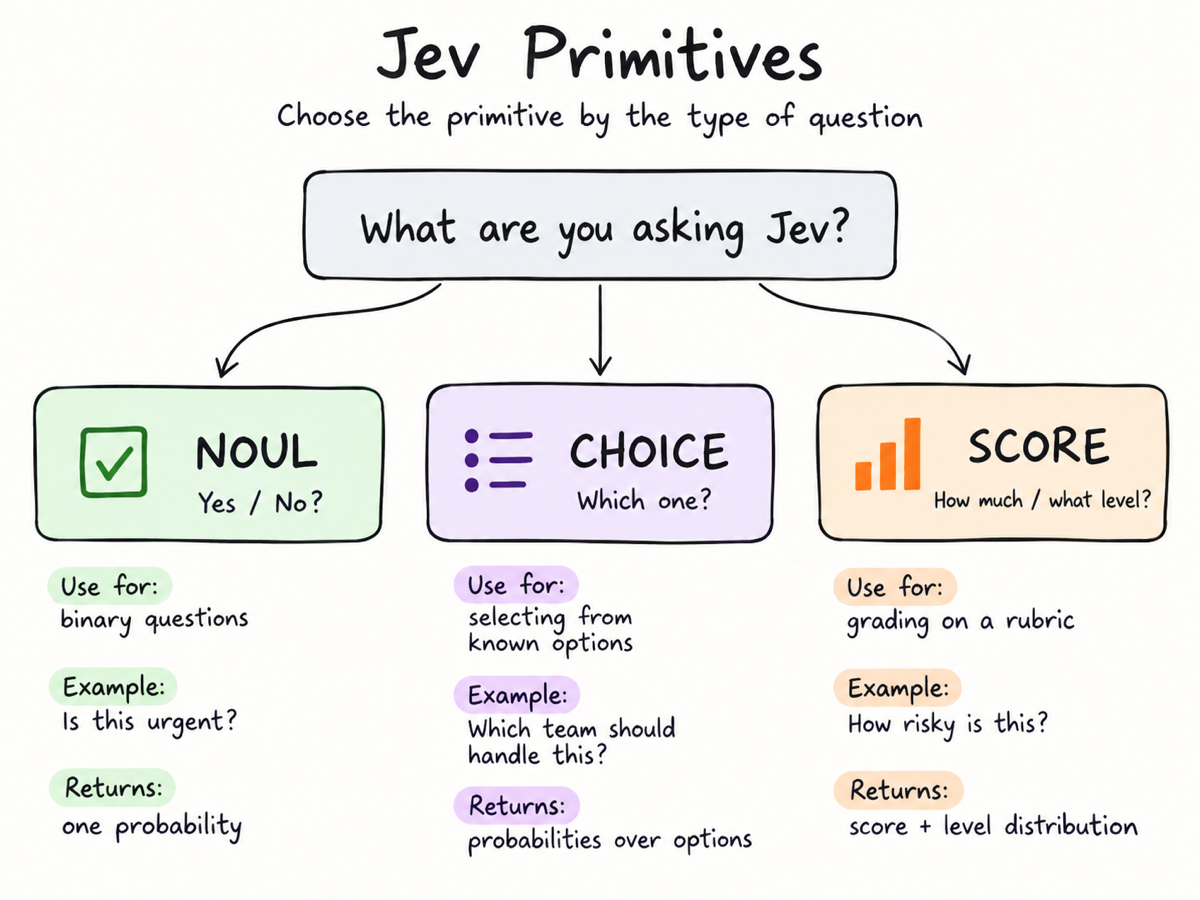 Jev Explaineddavila7/jev-explainedInteractive playground that walks through a typed request and its probabilities, with your own key.★ 27
TypeScript- jevscan-evmdevtooligan/jevscan-evmProduces a heat map of likely bugs in EVM code. The author's own warning: a proof of concept whose code they did not read.★ 26
Python - minojevzeredy879/minojevOpen replica: a 547k-parameter model that answers runtime-defined `Choice` (2-255 candidates), `Boolean`, and `Score` questions with dev-calibrated distributions in one forward pass and zero output tokens, trained from scratch on CPU with committed datasets, predictions, and ECE results (maze 0.016).★ 25
Python - Laya vs Jev arenaPromptEngineer48/laya-vs-jev-arenaModel comparison: races an open local model against Jev through Snake and a Mortal-Kombat-style arena, the same game code driving both.★ 24
JavaScript - Jev Capability AtlasZaious/jev-capability-atlasA bilingual map of where Jev holds up and where it breaks, built from recorded API calls rather than a leaderboard. Its LICENSE is not a recognised open-source license.★ 24
Python  PlayJevOmniJev/PlayJevGaming: open 0.8B vision-language model that reads one 448 px game frame, returns a probability over the moves the game lists in a single forward pass with no generated text, and hands its low-confidence steps to a search program, across ten browser games.★ 23
JavaScript RikkaHub PlusMiaoWuNYA/rikkahub-sillytavern-androidAndroid chat client with a built-in Jev client: it scores stored memories for relevance in batches before retrieval, and exposes Jev to the model as a callable judgment tool. Endpoint and key are set in its settings. Chinese documentation.★ 21
Kotlin- Agent Chaperoneagent-chaperone/agent-chaperoneAgent safety: MCP proxy plus hooks that screen a tool call before it runs and a tool result before the agent reads it, with 45 test files behind it.★ 20
TypeScript - Pi Jev Guardzszz3/Pi-Jev-GuidePi coding-agent plugin with rules configured by timing, plus risk checks, output redaction, and reminders on repeated failures. Chinese documentation.★ 20
TypeScript - Jev for Chromechy4pro/jev-for-chromeBrowser automation: unofficial Chrome extension port of Jev Ultrafast where a Jev `Choice` picks the operation and DOM element each step and two `Noul` checks (goal reached, stuck) veto a premature DONE or BLOCKED, with a small text model used only when text must be typed.★ 19
TypeScript - Jotrunta-dev/jotA general-purpose agent loop where Jev picks the next move and Jot runs it. No license file at the time of writing.★ 19
TypeScript - jev-useshitianfang/jev-useClaude Code, Codex and pi plugin that hands the agent steps needing no written output to Jev and leaves the prose to the LLM.★ 19
JavaScript - CheshiCheshiAI/CheshimacOS workspace for Codex where Jev finds past sessions and the decisions made in them. Apple silicon only.★ 18
C - lorenziniNanako0129/lorenziniClaude Code skills that wait for CodeRabbit, Copilot or Codex to finish reviewing a pull request, then judge whether the verdict actually permits a merge.★ 17
Shell 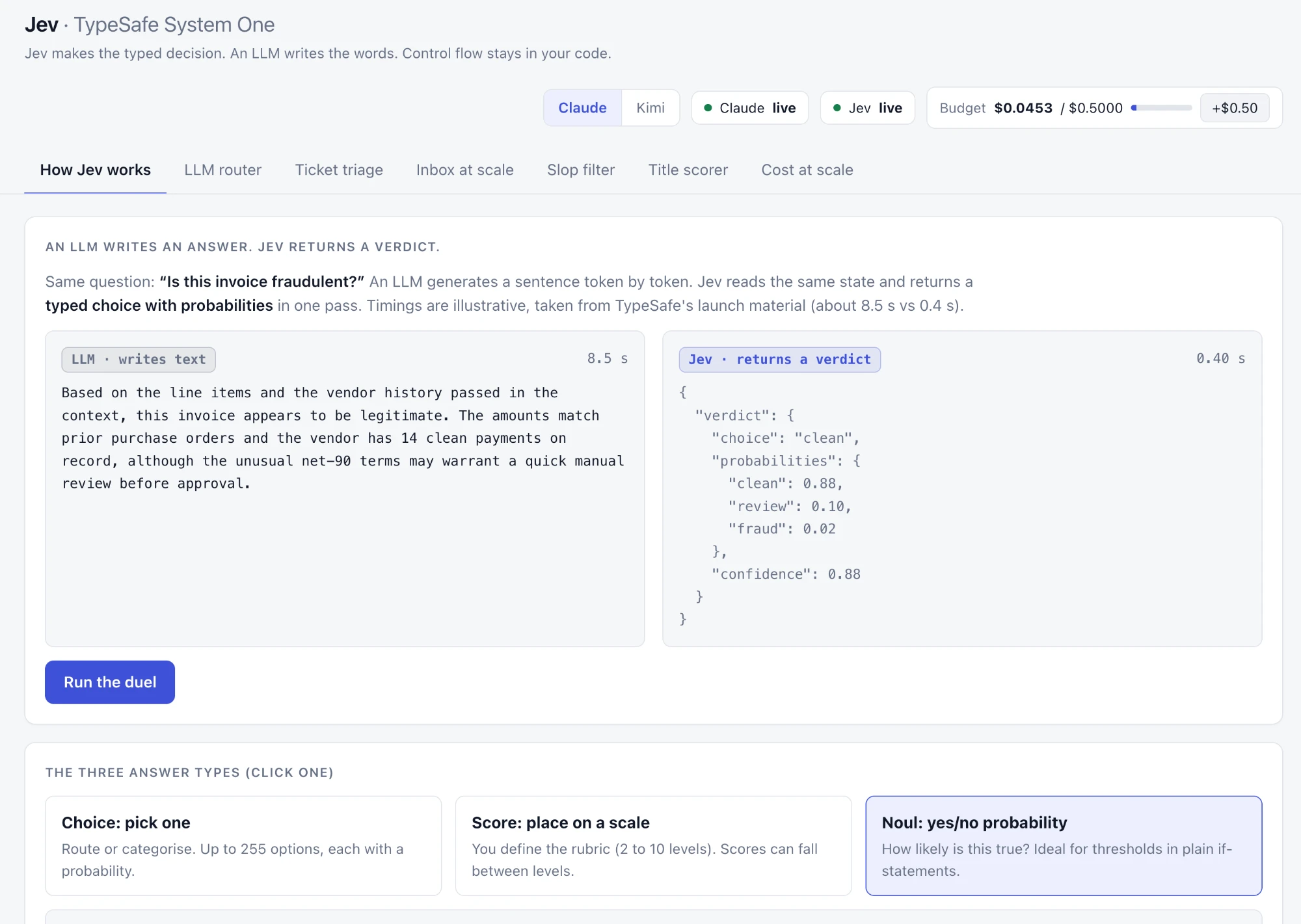 Jev demosmayank953/JevSeven side-by-side demos that run with no keys and label themselves simulated. Each visitor's key gets its own budget by fingerprint, and any key is redacted out of upstream errors.★ 17
JavaScript- jev-reflex-autonomy-labkhordoo/jev-reflex-autonomy-labDrone autonomy: a multi-drone lab where Jev supplies the reflex decisions, with an optional slower strategy layer guiding them.★ 16
TypeScript - JevForgezwliJay/jev-forgeOpen research: an end-to-end stack for auditable data construction, Qwen3.5-0.8B training, fixed Mind2Web and OOD evaluation, local serving, and a preliminary RLCD baseline.★ 16
Python - feelingsBoundaryML/feelingsBAML language support for an AI if-statement: `.feels()` as a real, typed method backed by a decision model.★ 15
BAML - jevvyPanAchy/jevvyPlugins for coding agents, starting with one that auto-approves shell permission requests it judges harmless and passes everything uncertain to the normal flow.★ 15
TypeScript - JarvisCorePrescott-Data/jarviscore-frameworkAgent frameworks: Python multi-agent runtime that ships Jev natively from 1.12, where agents ask typed `Choice`, `Score` and `Noul` questions through a decision client separate from the text model, the Kernel picks a specialist subagent by `Choice`, and each retrieved RAG passage is withheld from the generating model when its prompt-injection `Noul` exceeds 0.70.★ 15
Python - dsh-jevbuberlo/dsh-jevDecision layer for DeepSeek Harness whose failure policy rejects the value `allow` at configuration time, from plain JavaScript as well as TypeScript. Its verify script installs the built tarballs into a fresh consumer before testing them.★ 15
TypeScript - jgrep (kyu1204)kyu1204/jgrepDeveloper tools: semantic grep that asks Jev one Noul per 5-60 line code chunk, diff hunk or CSV row (16 per request) and prints grep-style file:line hits above a threshold, so English sentences work as CI lint rules.★ 15
TypeScript - jev-test-filtermizchi/jev-test-filterReads a Git diff, scores every test for whether the change can alter its outcome, and prints the arguments your runner already understands. Every failure path runs the whole suite instead, including a diff that did not fit the state budget.★ 15
TypeScript 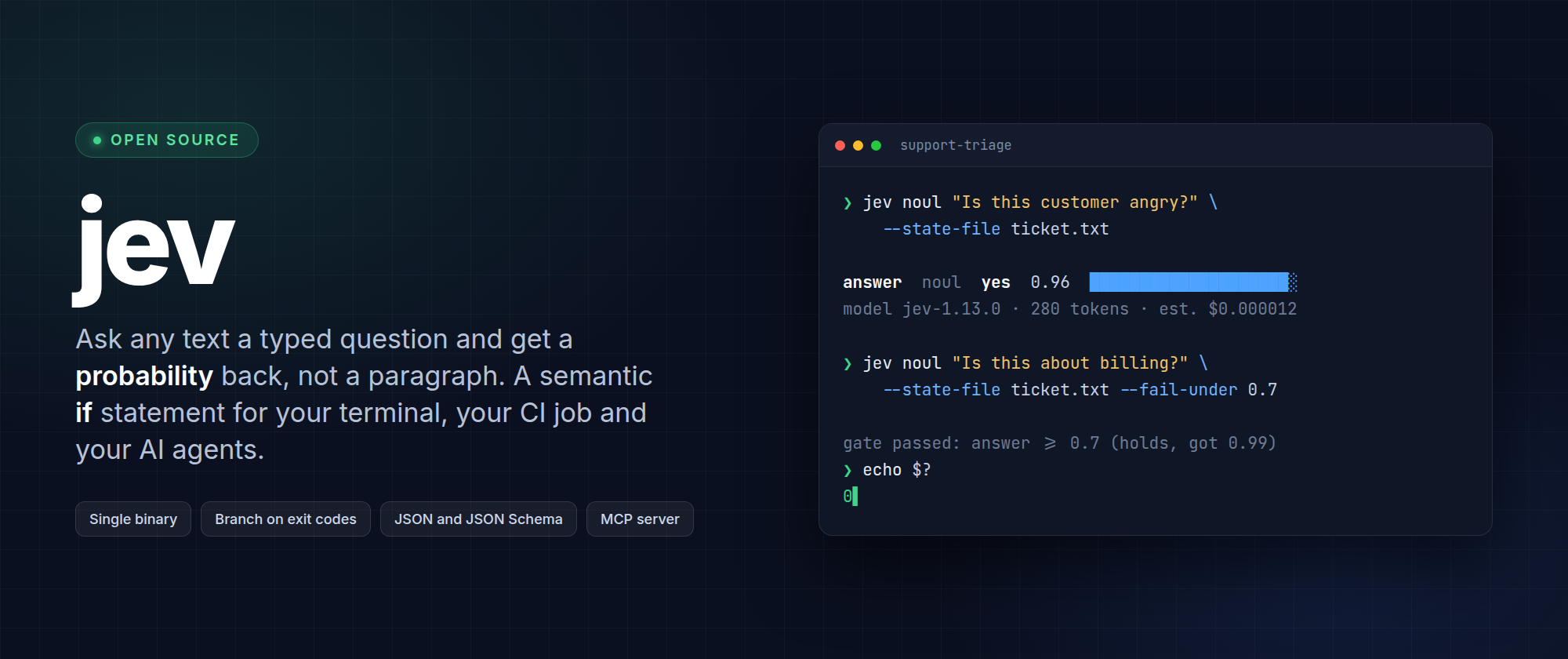 jev (shaharia-lab)shaharia-lab/jev-cliRust CLI whose exit codes separate a false gate from an answer inside your abstain band, so a script can take a third branch and ask a person. Lints the request before it spends anything.★ 15
Rust- Jev Studioutk2103/jev-studioOne pip install for experimenting: MCP tools for Choice, Noul and Score, prompt libraries and a slash command per cookbook recipe.★ 15
Python - JevLoopzjunlp/JevLoopAgent harness: routes the loop's own judgements to Jev, where a `Choice` picks the next tool from candidates rebuilt every step, a `Score` grades the call's risk, and a `Noul` decides whether it needs authorisation, while plain code acts on the answers so a high risk score forces human authorisation that no probability can override (7.7% of wall clock with the offline judge, 79% over the hosted API).★ 15
TypeScript - hunchcarldaws/hunchRuby ecosystem: turns judgment calls into control flow — `if Hunch.likely?("fraudulent", given: order)` reads like plain Ruby but branches on a typed Jev answer, with `pick` for Choice, `rate` for Score, and graded predicates from `possibly?` to `definitely?`.★ 14
Ruby 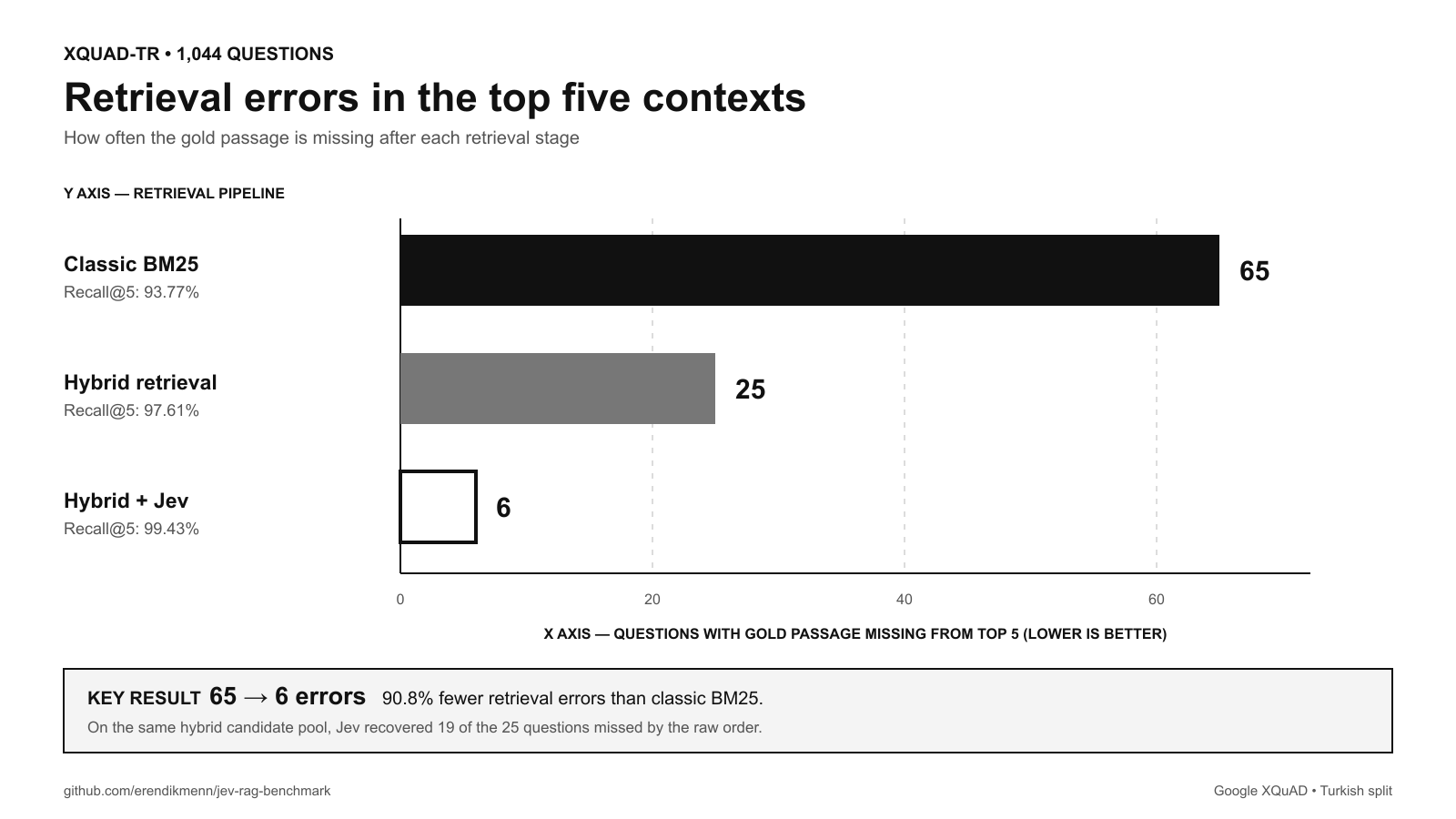 jev-rag-benchmarkerendikmenn/jev-rag-benchmarkReproducible experiments on whether reranking with Jev improves a small RAG system, on a locked Turkish dataset, with quality, latency and cost reported together.★ 14
Python- jev-mail-classifierparth-kp/jev-mail-classifierConfig-driven inbox classifier that tags, moves, flags and notifies from typed answers.★ 14
Python - yummy-pi-extensionssugarforever/yummy-pi-extensionsExtensions for the Pi coding agent, each released separately, including a Jev-based model router.★ 14
TypeScript - Jev vs. MLQuicqDev/Jev-vs-MLCompares a typed decision model with classical classification pipelines across eight datasets, with a published protocol and an interactive report.★ 13
Jupyter Notebook - Jev Directoryeveryai-com/jev-directoryRunnable evals and community builds, also served to agents as an MCP server and an `llms.txt` index.★ 13
HTML - jev-rerankerhotchpotch/jev-rerankerRetrieval and RAG: uses Jev Noul judgments to assess retrieved documents for relevance and usefulness as answer evidence, then sorts results and optionally filters them using a configurable threshold.★ 13
Python 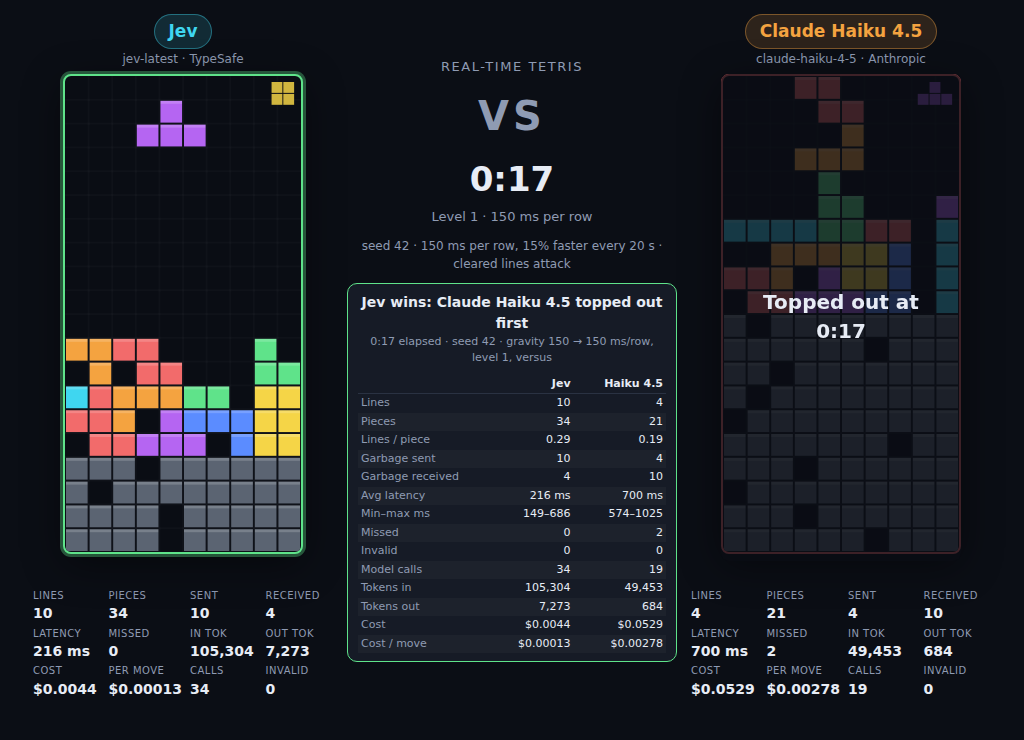 Jev Tetristrungdq88/jev-tetrisTwo models play Tetris on a shared seeded piece sequence under the same clock; a piece that lands before the answer arrives locks where it fell. No licence file.★ 13
JavaScript- FastJevchengyongru/fastjevLocal runtime: self-hosted Python SDK and System One-compatible API for runtime-defined `Choice`, `Boolean`, and `Score` decisions on pinned open models across Torch, vLLM, MLX, llama.cpp, and WebGPU, with committed row-level benchmarks and checksums.★ 12
Python - jev-ultralightspeedcollapseindex/jev-ultralightspeedPacks many items into one Jev request for bulk classification. If any item in a pack comes back unanswered it raises and names the item rather than returning a partial result.★ 12
Python - discerndoeixd/discernTypeScript ecosystem: Effect library where a Jev `Choice`, `Noul` or `Score` answer becomes a typed branch under caller-supplied thresholds, anything below them takes an `Uncertain` case the compiler forces you to handle, and procedure routing skips the model call entirely when deterministic predicates leave one candidate.★ 11
TypeScript - HelmJimuelle07/HelmPicks which of the coding agents on your machine should take a task, from an answer set a probe builds, so an agent you have not installed cannot be recommended. Installs as a Claude Code plugin, a Gemini CLI extension, or an Agent Skill.★ 10
Python - Jev Chat for Twitchethanplusai/jev-chat-for-twitchLive chat filtering: bring-your-own-key Chrome extension that reads a Twitch channel's chat over the anonymous IRC WebSocket, asks Jev one category `Choice` per message in batches of 20, and shows a second column of only the messages matching a chosen intent (helpful, questions, funny, feedback); about 504 input tokens per message, roughly $0.15 per hour on a 2-message-per-second chat and $0.76 per hour at 50 per second.★ 10
JavaScript - hearth-jev-rental-searchNancy-Chauhan/hearth-jev-rental-searchHousing search: autonomous multi-source rental search where Jev decides which listings match the criteria.★ 9
JavaScript - jev_antispam_botbackmeupplz/jev_antispam_botTelegram moderation: minimal grammY anti-spam bot that asks Jev about each message, with ten test files behind it.★ 9
TypeScript - flue-jev-demomatthewp/flue-jev-demoAgent routing: routes a Flue agent's work with Jev through Cloudflare AI Gateway.★ 9
TypeScript  OmniJevshapsider/OmniJevEmbodied robotics: a Jev-style finite-choice interface that feeds dual-camera images and text to a self-hosted multimodal model and takes the next preset skill for a MuJoCo arm as one typed choice, where released episodes finish transfer, stack and barrier tasks in 13 decisions and 39 output tokens each, 208/208 non-audio probe requests answer correctly, unobservable inputs come back "insufficient evidence" instead of a guess, and four public benchmark pilots hold accuracy equal to a direct short answer while cutting decision latency 6.8–13.6× and total tokens 51–86% (audio input is wired in the client but rejected by the current backend).★ 9
Python- Visual-JEVjiangxiluning/Visual-JevA visual Jev—a native multimodal Jev based on Qwen3.5-4B—that supports direct image input without requiring modality conversion.★ 7
Python - Lucescienthoon/luceOpen recipe: describe the decision task in a sentence, an LLM teacher writes the training data, a LoRA + decision head on Qwen3-4B-Base answers choice/score/boolean questions with calibrated probabilities in one forward pass; trains on a 12 GB card. Reports accuracy and ECE next to Jev on identical test items (rule-generated tickets 91.1 vs 75.1, phishing 97.4 vs 62.6, GitHub issue priority 41.1 vs 37.5); browser replay demo without a GPU.★ 7
Python - BrowserClawGoldenLoaf24h/browserclawBrowser automation: Zero-lock, session-preserving Chrome MCP server that couples a local Jev System One semantic micro-loop (`chrome_act_toward_goal`) with an 85%+ pruned DOM tree (Shadow DOM & iframe pierced), dispatching native CDP events (`isTrusted: true`) on active logged-in sessions without focus theft.★ 6
TypeScript - Spike: Jev as a judgement layer to cut model costopen-orcha/orchaIssue: a multi-agent orchestration platform plans to move judgment out of its model-of-thought and onto Jev, framed as cutting cost while holding quality.★ 6
Python - rotomRyanKung/rotomLocal gateways: OpenAI- and Anthropic-compatible API gateway that carries Jev through its model catalog and evaluation path.★ 5
Rust - jev-goStumble/jev-goGo ecosystem: community Go SDK for Jev.★ 5
Go  Okobartlomein/okoDeveloper tooling: local code search for coding agents that shortlists function-level chunks with ripgrep and BM25, asks Jev a `Noul` relevance question per chunk across three parallel requests, and returns the accepted ones as excerpts through MCP; the cutoff and excerpt selection live in code.★ 5
Rust jev-usecaseskenhuangus/jev-usecasesReference harnesses: a set of production-shaped use-case harnesses built around confidence-gated decision logic.★ 5
Python- 2048 × JevARCJ137442/jev-2048Gaming: a 2048 board where every move is a Jev `Choice` over four directions with no heuristic fallback, gated by a user-set confidence threshold that pauses play for human review, with editable prompts and board rules, bring-your-own-key backends, and archive import/export.★ 4
TypeScript - nlgrepYehuiTang0316/jev-nlgrepDeveloper tooling: uses Jev `Noul` judgments to find code, docs, logs, and text satisfying natural-language conditions, with a configurable probability threshold and ranked file results linked to source lines.★ 4
TypeScript - jev-harnessismaelsoilet/jev-harnessDeveloper tooling: gates AI coding agent execution with Jev `Choice`, `Score`, and `Noul` decisions, triaging test tracebacks in < 2ms to resolve dependencies deterministically without frontier LLMs and aborting circular doom loops.★ 4
Python - 深入解读 Jev 模型:毫秒级判定与工程边界kuhung/understanding-jevChinese deep-dive: examines Jev's millisecond judgments and, more usefully, where its engineering boundaries lie.★ 4
HTML - taste-lintmblode/taste-lintWriting / UI: CLI that uses Jev probabilities on semantic taste checks to catch AI slop in UI, copy, and agent instructions before ship; measurable rules stay local and active findings can fail a run.★ 4
TypeScript  Tab SorterAstonyCat/jev-tab-grouperBrowser tooling: Chrome MV3 extension that groups every tab in the window into named, colored Chrome tab groups from one parallel Jev call — one `Choice` question per tab against user-editable group criteria — with unclassified tabs falling to a fixed fallback bucket, manual groups untouched, and the pre-grouping tab order restored on ungroup; an optional LLM engine with self-invented group names is included for comparison runs.★ 3
JavaScript- jev-compactionWaxmell114514/jev-compactionContext management: standalone agent context compactor where Jev only scores transcript segments — kept lines stay verbatim, low scorers move to a store behind an expand() pointer instead of being deleted, and the append-only frozen prefix keeps the prompt cache valid; runnable offline demo, no API key needed.★ 3
Python - jevkitariel-frischer/jevkitDeveloper tooling: Rust CLI that validates `Choice`/`Score`/`Noul` question sets with 13 offline lint rules before any Jev call, then sends the canonical wire payload and prints parsed, confidence-bearing JSON answers to stdout using exit code 2 to reject a billed-but-useless request.★ 3
Rust - jev-canvasgaborishka/jev-canvasMultimodal UI: draw on a tldraw canvas by voice while pointing a webcam-tracked finger; on every partial transcript Jev answers eight typed questions (is it a command, is the sentence complete, action, shape, colour, target, place, size) and plain code gates them with thresholds, in English and Ukrainian, 300–550 ms per decision.★ 3
JavaScript 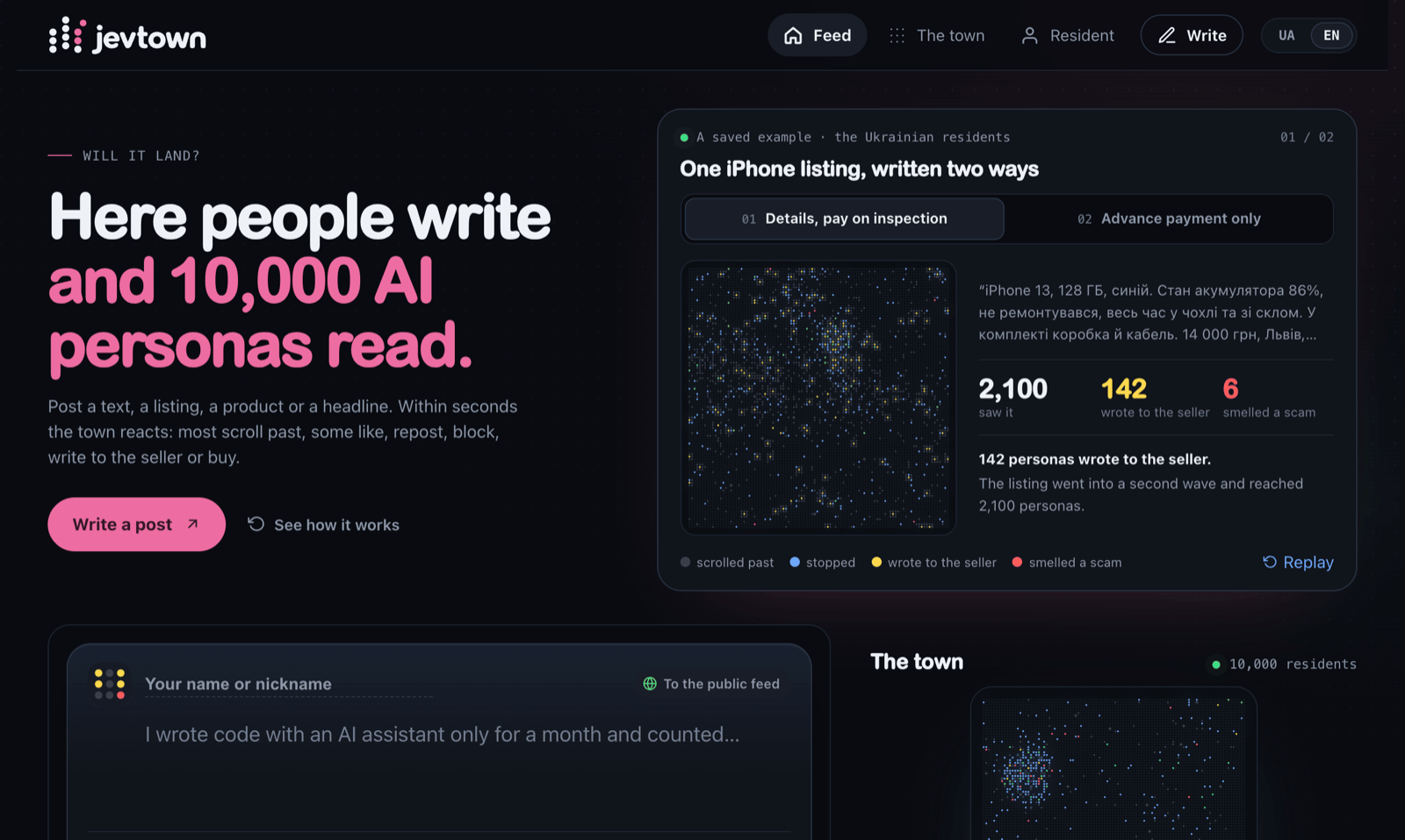 Jevtowngaborishka/jevtownAudience simulation: a town of 10,000 personas computed from their id reads a post, listing, product or headline; one request asks Jev about 60 `Score` questions on who would care plus seven `Noul` moderation checks (0.5 keeps the text out of the public feed, 0.85 blocks it), batched `Choice` questions then return each persona's reaction in waves of 600, 1,500 and 3,000, and code sends the text to the next wave only while glad reactions outweigh sorry ones by at least 0.1 of the wave.★ 3
JavaScript- jev-assistglud123/jev-assistCoding agents: ranks every tracked file by relevance to a one-line task description — Jev asks each file the same typed question in parallel batches, so an agent in a 600-file repo starts from the handful it actually needs — with a validate command that grades the ranking against past commits.★ 3
JavaScript - omo-jevlike-routerislee23520/omo-jevlike-routerSkill routing: shrinks the skill catalog in a system prompt with one forward pass over a frozen Qwen, routing each request Jev-style.★ 3
Python - Jev IDSjev-ids/jev-idsNetwork security: Intrusion Detection System (IDS) prototype built on Jev. It takes the metadata of a network flow and returns a verdict on whether the flow is an attack and its threat category, with probabilities. On a well-known cybersecurity benchmark (NSL-KDD), Jev IDS was compared against a state-of-the-art LLM (GPT-5.6 Luna) and a Machine Learning model (Random Forest). It was 4.8× faster and 3.8× cheaper than the LLM. It also raised 15× fewer false alarms than the Random Forest.★ 3
Python - sqlite-jevmgaitan/sqlite-jevSQLite ecosystem: loadable C extension and Python package that expose Jev Noul, Choice, and Score judgments as SQL functions and batched virtual-table queries with confidence results.★ 3
C - Jev Web Analyzerreplynodes/jev-web-analyzerProduct evaluation: analyzes a public SaaS landing page as clean Markdown and asks Jev ten bounded `Choice` questions about first-visit understanding, returning inspectable findings for the first change to make.★ 3
TypeScript  Jev Reranker (Rust CLI)shinpr/jev-rerankerRetrieval and RAG: JSON-in/JSON-out CLI that uses separate Jev `Noul` checks to rank candidates, apply evidence thresholds, or extract source text while keeping those decisions independent.★ 3
Rust- Soupbasespoonnotfound/soupbaseGaming: uses Jev `Choice` judgments to answer lateral-thinking puzzle questions and assess proposed solutions, with application code requiring supported facts, a coherent explanation, and sufficient confidence before marking a puzzle solved.★ 3
TypeScript - GUI JEV HarnessZihuaEvan/GUI_JEVComputer use: recursive screenshot grounding where Jev returns a `Choice` over grid-tile candidates at each level, and local probability and margin gates decide whether to descend or refuse, emitting only a raster point and bounding box and never clicking.★ 2
Python 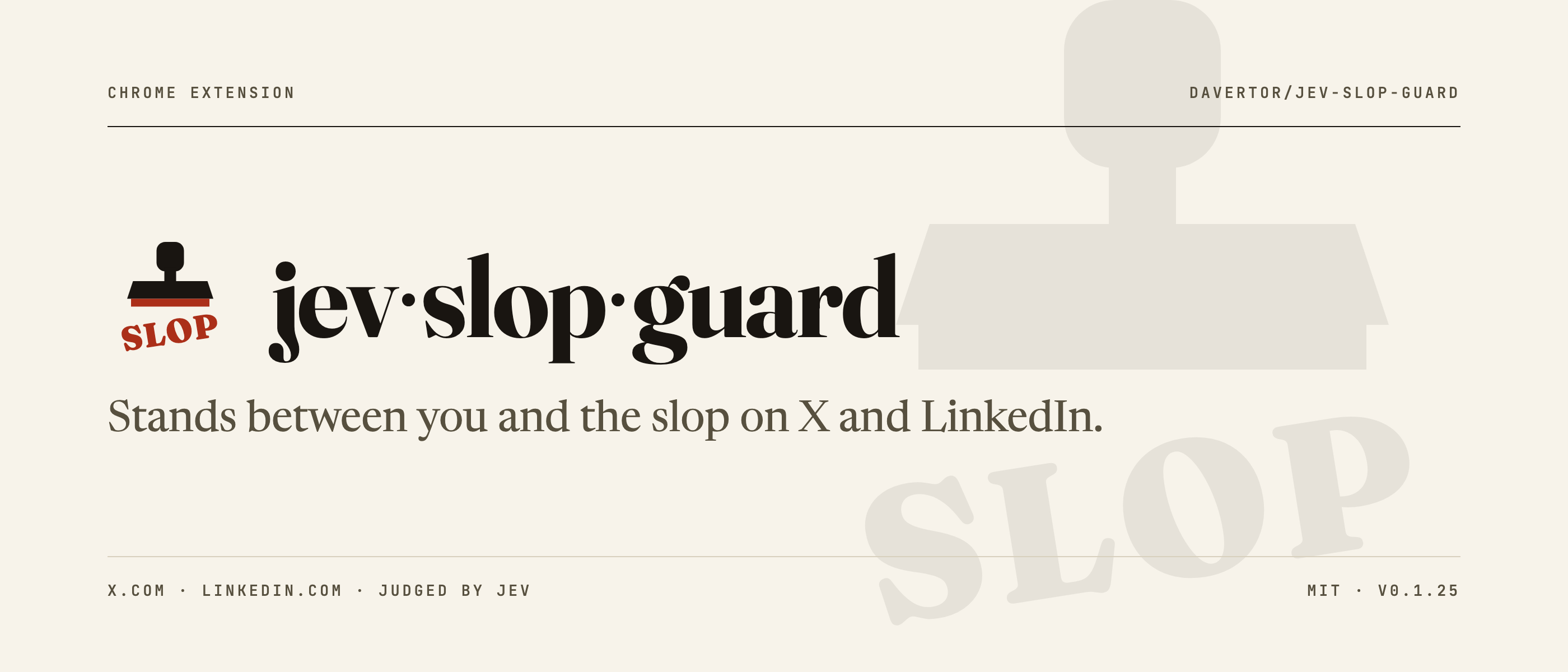 jev-slop-guarddavertor/jev-slop-guardSocial feed filtering: bring-your-own-key Chrome extension that asks Jev one `Choice` (`slop` / `not_slop`) per X and LinkedIn post as it scrolls into view, blurring and stamping anything at or above a user-set threshold (default 0.7) behind a "Show the post" override, with a three-request concurrency cap and one cached verdict per post so scrolling never blocks.★ 2
JavaScript- jevlike-esp32david-cermak/jevlike-esp32Edge deployment: exports a jevlike scorer as ESP32 firmware with a C scorer and a host-side check, putting one-pass decisions on a microcontroller.★ 2
Python  s1_rubyinnocentdiaz/s1_rubyRuby ecosystem: makes System One measurement, and the collapse that follows it, a Ruby primitive, with a TypeSafe provider behind its own spec suite.★ 2
Ruby- JevLoopparkavenue9639/jevloopAgent runtimes: a Python runtime where Jev `Choice` decisions select tools and targets, uncertain decisions escalate to an LLM, and a shared guarded kernel supports isolated Docker workspaces and paired LLM-only comparisons.★ 2
Python - DWIMrohit9mehta/dwimDesktop productivity: a macOS command palette that reads the frontmost app's menu tree through the accessibility API, asks Jev one `Noul` per menu item against the user's plain-language request, and presses the top match when it clears a probability threshold, falling back to a ranked list otherwise and never auto-running destructive items.★ 2
Swift - profanity-checker4rays/profanity-checkerTrust & safety: Cloudflare Worker that asks Jev `Noul` for literal profanity in text or usernames and a second `Noul` for phonetic or look-alike disguise (`a55h0le`, `mike_hunt`); the threshold, `max()` policy, JSON response, and OpenAPI schema live in Worker code and the endpoint is callable from other Workers via service bindings.★ 1
TypeScript - GeekLink Jev Subtitle TranslatorGeekLinkDev/jev-subtitle-translatorSubtitle translation: asks Jev a `Noul` review question for each translated subtitle line to flag omissions, changed meaning, names, numbers, negation, or other defects for human review before export.★ 1
Python - kojevItisNoMatter/kojevKotlin ecosystem: Kotlin Multiplatform (JVM, Android, iOS) client for Jev that answers Choice and Score questions as the caller's own enums, with one typed way to read answers, no default thresholds, and offline MockEngine tests.★ 1
Kotlin - Jev by ExampleReallyArtificial/jev-by-exampleAgent development: runnable JavaScript lessons use Jev Choice, Score, and Noul judgments for memory reconciliation, recovery proposals, and handoff checks, with explicit application policies, offline fixtures, and opt-in live calls.★ 1
JavaScript - r2r-jevThneoly/r2r-jevAgent governance: asks Jev two `Noul` checks per tool call (beyond scope, destructive) and admits each judgment as Evidence that can degrade Trust, Delegation, and Authorization until a human override repairs the relation, so later calls inherit the history; includes a stateless-vs-stateful comparison with a scenario adversarial to persistence.★ 1
Rust - jevgrep (allebee)allebee/jevgrepLog triage: filters logs and other text streams, including live `tail -f` output, by asking Jev one Noul per line against a plain-English question and printing lines at or above a probability threshold, with a hand-labelled benchmark against Claude in the repository.★ 1
Python - CloJevantlobach/clojevClojure ecosystem: unofficial portable Clojure SDK for System One, so Clojure applications can put typed questions to Jev without a Java interop layer.★ 1
Clojure - hunchoedgardcham/hunchoTypeScript ecosystem: dependency-free SDK that turns Jev `Noul`, `Choice` and `Score` answers into named decisions with `enter`/`exit` thresholds (hysteresis), nested decision trees settled in one call, a JSONL journal, replay of a threshold change over recorded answers with no inference, and Brier/reliability calibration, over TypeSafe direct, OpenRouter or Vercel AI Gateway.★ 1
TypeScript  jev-engineeringeugeniughelbur/jev-engineeringAgent safety: gates coding-agent tool calls with deterministic rules first and one typed Jev call second, then publishes a rerunnable 300-call injection test showing what the gate catches and what walks past it.★ 1
Python- Jev Wrappedgaborishka/jev-wrappedMedia analysis: reads up to 1,500 posts from the last year of a public Telegram channel and asks Jev a `Choice` over ten kinds of post plus three `Noul` questions (paid ad, clickbait, emotional pressure) about each, counting an ad from 0.7, or from 0.4 when the kind is also ad, and clickbait and pressure from 0.5, then draws the monthly mix on a shareable card that links the highest-scoring posts for a manual check.★ 1
JavaScript - Jev vs GPT-4.1 on a synthetic surveyjjd-lab/jev-synthetic-surveySurvey research: runs Jev and GPT-4.1 as the same 300 synthetic respondents over 24,596 paired Twin-2K-500 cells under criteria fixed in advance, finding that asking a yes/no item as `Noul` rather than `Choice` moves the result more than the gap between the two models, at a thirty-fourth of the cost. Write-up: [jjd-lab.github.io](https://jjd-lab.github.io/jev-synthetic-survey/)★ 1
Python - jev-logtriagejyatesdotdev/jev-logtriageOn-call operations: batches collapsed Loki logs into one Jev call of Noul, Score, and Choice questions, then maps answers in code to suppress, watch, review, notify, or page, with low confidence going to review and nothing executed.★ 1
Python - typesafe-sdk-javakgonia/typesafe-sdk-javaZero-dependency Java client (Java 21+).★ 1
Java - ask-jevlogicrw/ask-jevPython ecosystem: zero-dependency CLI that routes small semantic judgments — Choice, Noul, Score, batch questions, and verbatim passage extraction — to Jev for AI agents and CLI pipelines.★ 1
Python  jev-oncallmingleiw/jev-oncallOn-call operations: asks Jev one call of four typed questions per alert (`Noul` actionable, `Score` severity, `Choice` owning team, `Choice` duplicate-of), pages on P(SEV1)+P(SEV2) ≥ 0.80 and drops only below 0.20 when actionability agrees, sends the band between to a human who has 15 minutes to ack before it pages anyway, links duplicates into a cycle-broken incident graph so two alerts can never silence each other, and falls back to configured severity on any error or timeout; a published 300-alert run measured p50 418 ms, p95 1477 ms and $0.04 per 1,000 alerts, with the slowest call landing 151 ms short of the 2 s timeout.★ 1
Python- jev-resume-screeningnanami-0713/jev-resume-screeningRecruiting: screens one resume against a JD in a single request of five Noul evidence gates, four Score dimensions, and one background-routing Choice, with criteria hardened v1→v3 against negative-control resumes (a glossy-trap CV's self-described "AI heavy user" fell 0.95→0.49) and any low-confidence answer escalated to human review.★ 1
JavaScript - Jev-Mailvynnlee/jev-mailEmail productivity: runs a 24/7 Gmail classifier on user-owned Google Apps Script where Jev scores urgency, importance, and category, routing uncertain or suspicious mail to Review without a local daemon.★ 1
TypeScript - n8n-nodes-typesafezampierid4p/n8n-nodes-typesafen8n community node for asking typed questions inside workflows.★ 1
TypeScript  DataJevzzz1YAO/DataJevData analysis agents: an LLM performs Python-based analysis while Jev reads the compressed analytical state and decides whether the agent should continue the current direction, switch to another one, verify a finding, or stop and synthesize the answer.★ 1
Python- Life Chess × JevARCJ137442/jev-lifeExperimental game design: a turn-based Conway board where each side's move is one Jev `Boolean` per legal cell in a single request, with no heuristic fallback and a user-set confidence threshold flagging unsure turns; the game is new, so there is no established play to copy, and its rules are not self-evident — they render from editable templates with auto-filled placeholders, so a designer can rewrite a rule and re-ask.★ 0
TypeScript - PlotVeilDearest/plotveilSpoiler protection: Chrome extension that covers each YouTube comment while one Jev `Noul` question, batched 20 at a time, answers whether it reveals a concrete plot event of the video being watched or of another title the user protects, with the extension owning the 0.85 / 0.7 / 0.5 threshold and keeping the comment covered when the check fails.★ 0
TypeScript 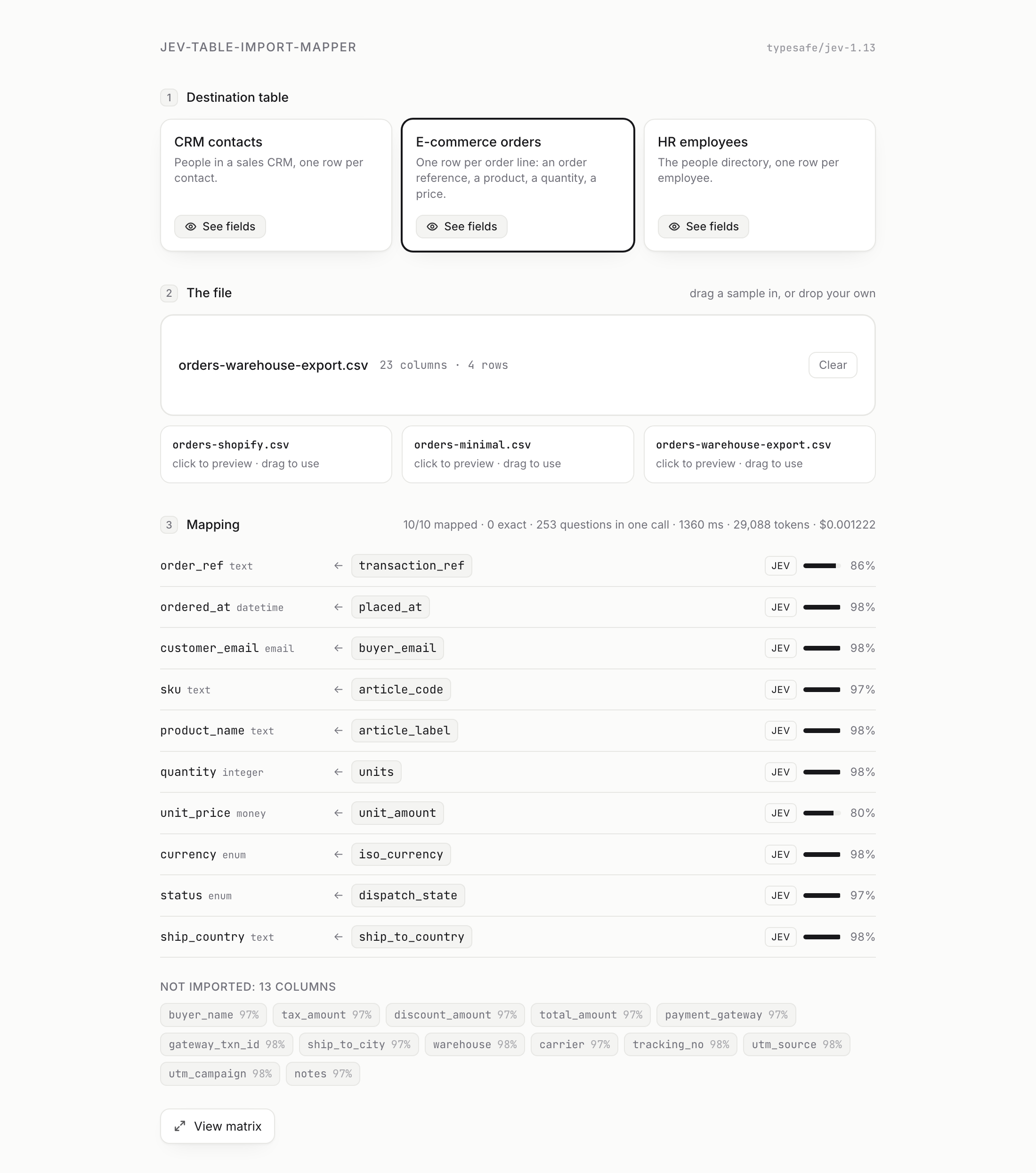 jev-table-import-mapperDuvInc/jev-table-import-mapperData import: maps an uploaded CSV's columns onto a destination table with a strict deterministic name-equality pass, then one Jev `Noul` per remaining (source, destination) pair plus a guard `Noul` per incoming column, mapping 10 of 10 columns of a 23-column export at 253 questions in one call, 915 ms, $0.0012, unmapped fields left visible above a 0.75 threshold rather than guessed.★ 0
JavaScript- Diffusion JevHangzhi/diffusion-jev-sglangVisual classification: independent Jev-style DiffusionGemma/SGLang server that selects doodle and flower labels from image pixels with typed Choice questions and displays candidate scores in a drawing playground, with public evaluation artifacts and uncalibrated probabilities.★ 0
Python - jev-evalShogo-nfrealmusic/jev-evalThird-party check: compares Jev against GPT-4o-mini and Claude Sonnet 4.5 under identical conditions on the same judgment task.★ 0
TypeScript  Feed LensSkywalkerDarren/feed-lensSocial media: uses Jev `Noul` judgments against per-platform, user-defined topic and expression labels to annotate Weibo, Threads and X posts directly in a Chrome extension.★ 0
JavaScript- jev-replaoprisan/jev-ts-replTerminal REPL for shaping System One requests before writing code. Simulates answers when no API key is set.★ 0
TypeScript - openrouter-jev-mcpctmx/openrouter-jev-mcpMCP ecosystem: Python decision gateway and stdio MCP server exposing TypeSafe's Jev model through OpenRouter's alpha decisions endpoint.★ 0
Python - Jev Chess Labdenikuchero/jev-chess-labRecorded chess experiments with a candid result: Jev on its own still blunders pieces.★ 0
Python 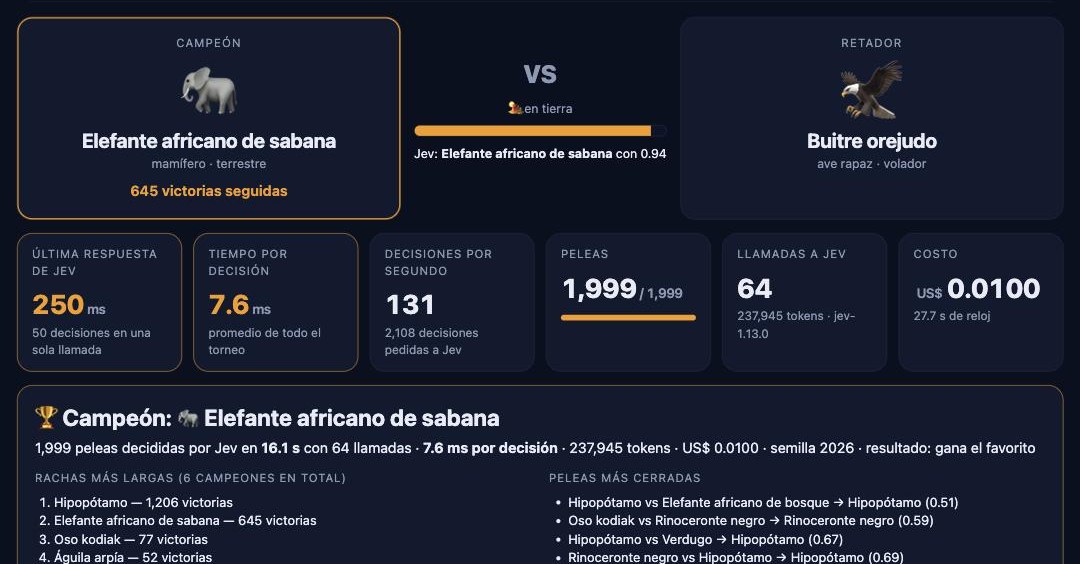 jev-torneo-animaleshectorlcastro09/jev-torneo-animalesGaming: winner-stays-on tournament of up to 2,569 animals where each fight is one Jev `Choice` between two names under land, water or air rules held in `state`, asking the champion against the next K challengers in a single request and discarding the speculative answers once the champion falls — 1,999 fights in about 16 s at roughly US$0.01.★ 0
HTML- ASSAY-001jourdanlabs/assay-001Independent pre-registered check of Jev calibration and type safety on Banking77 / CLINC150. Split verdict, full logs. Write-up: [donttrustme.ai](https://donttrustme.ai/assay-001.html)★ 0
Python 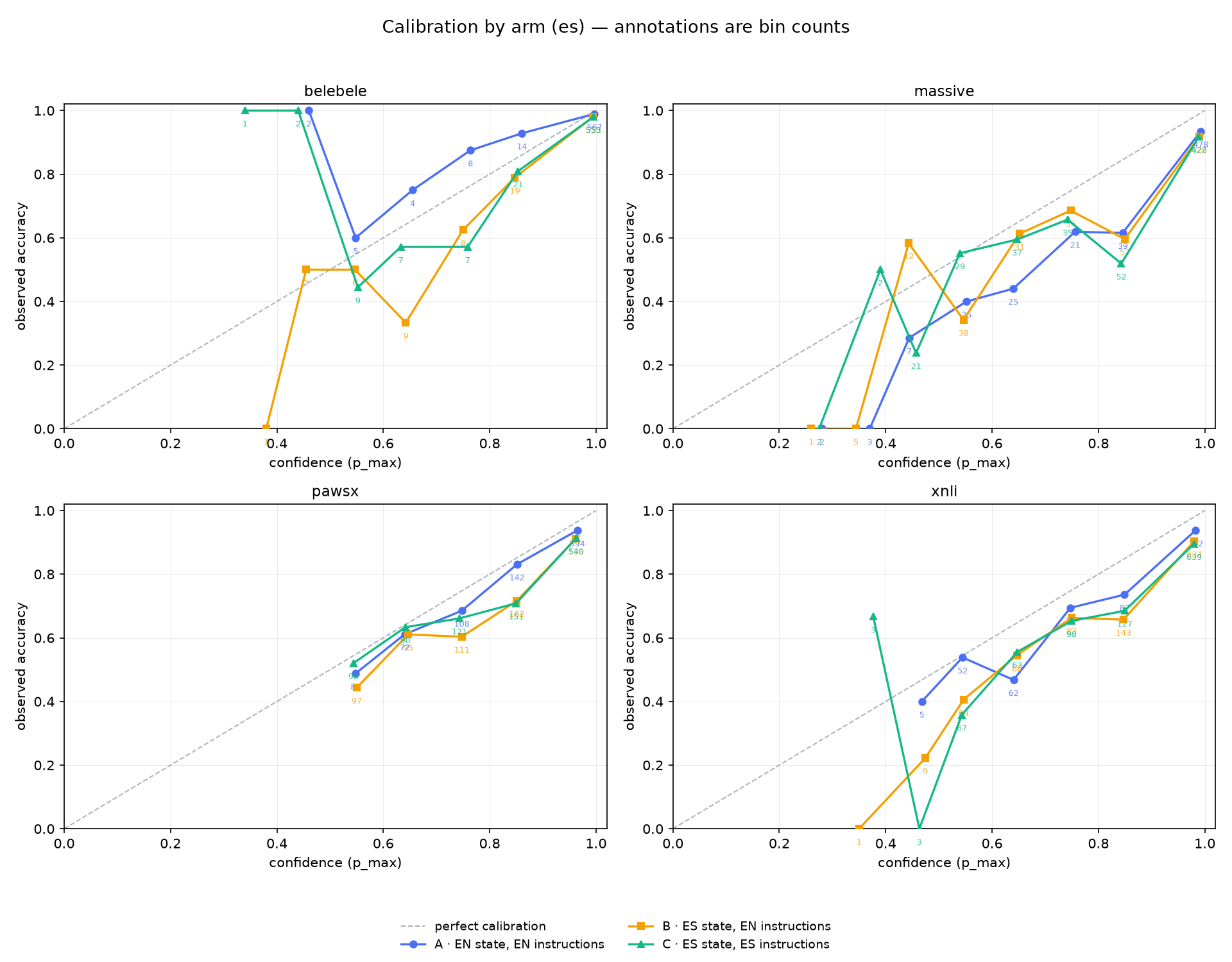 jev-acentomarcosmartinez/jev-acentoLanguage evaluation: pre-registered paired audit of Jev on Spanish over 3,200 human-labelled items, finding that a Spanish `state` costs 3.0-6.4 pp of accuracy and roughly doubles ECE on XNLI and PAWS-X while writing `instructions` in Spanish changes nothing, and shipping a CLI to rerun the same comparison on your own labelled data.★ 0
Python- grokbot-jev-jobsmcgalleg/grokbot-jev-jobsJob search: a daily Vercel cron that scores public job postings against one resume with Jev through the Vercel AI Gateway, so only the plausible matches surface.★ 0
TypeScript - jev-gatesrashedInt32/jev-gatesSeven calibrated gates for Claude Code (rules, scope, intent, done, claims, proof, and commit honesty) that escalate but never approve.★ 0
JavaScript - wakegateshitianfang/wakegateLong-running agents: before a sleeping agent's LLM is resumed on a timer or incoming event, Jev answers a `Choice` (wake, not yet, unrelated) against the agent's own sleep note, and code skips the wakeup only when wake is below 0.2 while always waking on user messages, bare timers, a skip limit, errors, and timeouts; one run passed 21 of 21 hand-written scenarios, which the README calls a smoke test rather than a benchmark.★ 0
TypeScript - jev-testsouvikr/jev-testModel benchmarking: reproducible test harness evaluating TypeSafe Jev Noul, Choice, and Score decisions via OpenRouter's Decisions API, comparing latency and accuracy against LLM prompt-and-parse baselines.★ 0
Python - AI-decision-makerzlZayn/AI-decision-makerData cleaning: asks Jev `Choice` questions to classify CSV columns into a 13-code type vocabulary and each dataset into one of six scenes, then executes every write locally; measured Jev at 6.6–12.7× an LLM's token cost on this task because the output is already one character while per-question criteria repeat.★ 0
Python